Why Does My Child Bite Their Nails or Suck Their Thumb? A Parent’s Guide to Understanding These Habits


Founder, Younglabs — partner across your child's learning journey
Engineering gold medallist · ISB Postgraduate · Building Younglabs across Foundations, Academic Excellence, University & Beyond
8 Sept 2026 · 7 min read
_____________Education
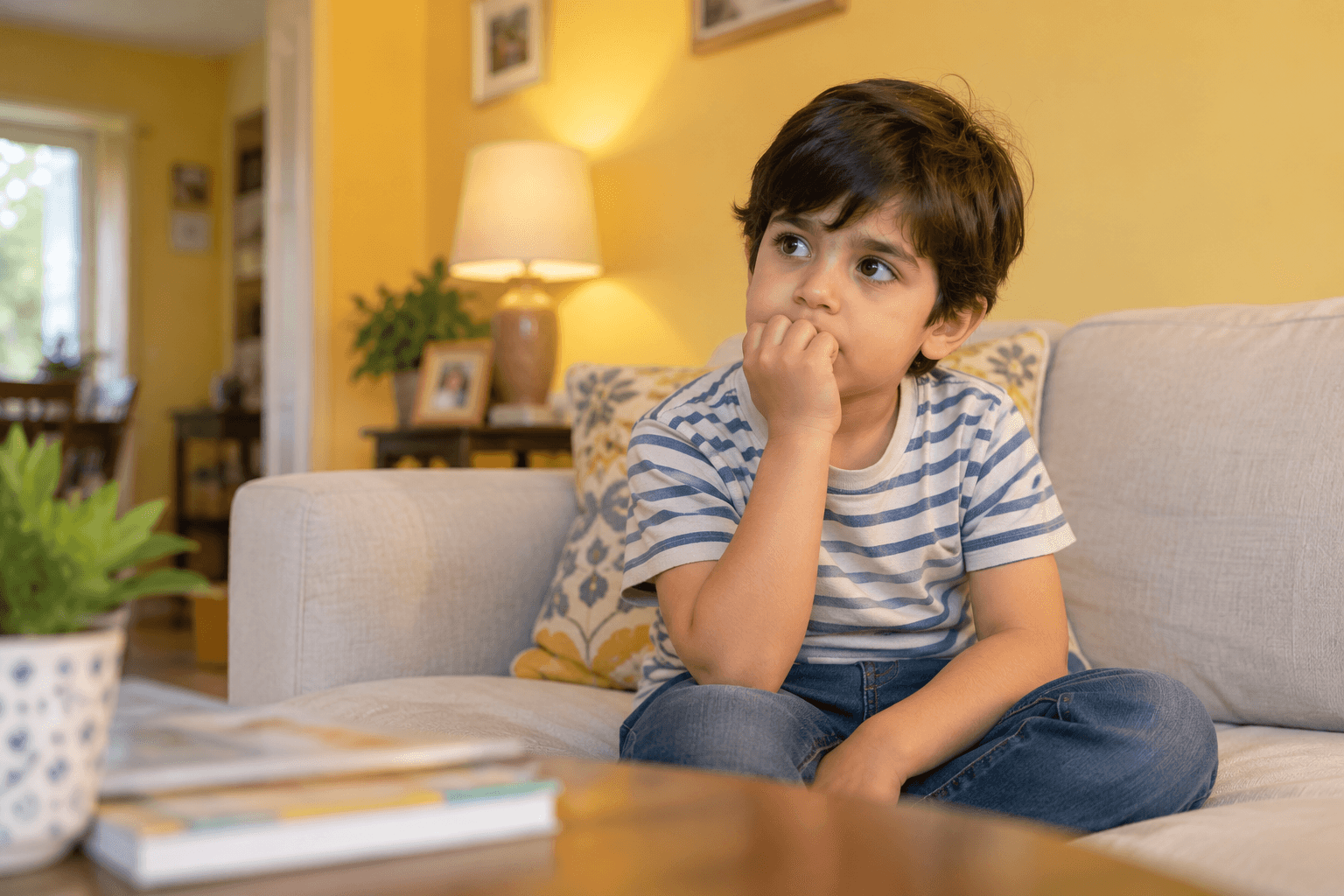
If you have a child who bites their nails or sucks their thumb, you've probably said something like this more times than you can count:
“Stop biting your nails!”
or
“Take your thumb out of your mouth!”
And then, a few minutes later, they're doing it again.
It can be frustrating for parents, especially when the habit seems to happen without any obvious reason. Your child might bite their nails while watching TV, doing homework or feeling nervous. Another child might put their thumb in their mouth whenever they're tired, bored or looking for comfort.
The important thing to remember is that these behaviours can become automatic habits. Your child may not even realise they're doing them.
So before turning it into a daily battle, it helps to understand where these habits may come from.
Why do children bite their nails or suck their thumb?
There isn't one universal reason.
Some children bite their nails when they are nervous, worried or stressed. You may notice it more around exams, a new school, unfamiliar situations or other changes in their routine.
Thumb sucking can also be comforting for some children, particularly when they're tired, upset, bored or trying to settle themselves.
But these habits aren't necessarily signs of a psychological problem.
Sometimes a child simply develops a repetitive habit. Nail biting may start during a stressful period and continue even after the stress is gone. Similarly, thumb sucking can begin as a comforting behaviour and gradually become something the child does automatically.
Boredom and concentration can also play a role. You may find your child biting their nails while watching their favourite cartoon or sucking their thumb while lying in bed.
The key is to look for patterns instead of immediately assuming something is wrong.
Why should parents address these habits?
For nail biting, one of the obvious concerns is hygiene.
Children touch toys, school desks, playground equipment and countless other things throughout the day. Dirt and microorganisms can collect around their nails and fingers, and when those fingers go into their mouth, they are being brought along for the ride.
Frequent nail biting can also damage the nails and the skin around them.
Thumb sucking has a different set of concerns, particularly when it continues for a long time or becomes a persistent habit. Depending on the child's age and how frequently they suck their thumb, parents may want to discuss the habit with their pediatrician or dentist.
The bigger issue with both behaviours is that habits can become harder to break when they are repeated over and over again.
Why doesn't telling them to stop work?
Because they may not realise they're doing it.
A child can hear “Don't bite your nails” several times a day and genuinely try to stop. But once they're distracted, nervous or deeply focused on something, their fingers may automatically find their way back to their mouth.
The same can happen with thumb sucking.
This is why constant scolding isn't necessarily the most helpful approach. Instead, parents can try to make the child more aware of the behaviour.
For example:
“Did you notice your hand just went to your mouth?”
That's very different from:
“Stop doing that!”
The first approach helps the child notice the habit. And awareness is an important part of changing an automatic behaviour.
What can parents do?
Start by figuring out when the habit happens.
Does your child bite their nails when they're studying? Does thumb sucking happen mainly when they're tired? Does either behaviour appear when they're anxious or bored?
Once you notice the pattern, you can start addressing the trigger.
Keeping nails short and clean is a simple step for children who bite their nails. For either habit, you can also try giving your child something else to do with their hands during situations where the behaviour usually occurs.
And don't underestimate positive reinforcement.
If your child manages to get through homework without biting their nails, or watches a whole programme without sucking their thumb, acknowledge it.
“I noticed you didn't bite your nails today. That's great!”
Small encouragements can be much more useful than repeatedly pointing out mistakes.
What if the habit continues?
For some children, awareness and encouragement aren't enough.
This is where a habit-breaking aid can be useful.
Docura No Bite is designed to help discourage both nail biting and thumb sucking. It contains 1% Denatonium Benzoate, an extremely bitter-tasting ingredient. The bitter taste acts as a deterrent when the child brings their fingers to their mouth.
The idea isn't to punish the child.
Instead, it provides a simple sensory reminder:
Finger goes to mouth → bitter taste → child notices the behaviour.
For a child who has been doing this almost automatically, that reminder can help bring the behaviour back into their awareness.
Docura No Bite is transparent when applied and is designed to dry without leaving a sticky residue or strong smell.
Parents looking for a practical aid to use alongside positive reinforcement and other habit-breaking approaches can learn more about Docura No Bite.
Don't forget what's happening underneath the habit
If a child suddenly starts biting their nails more frequently, or begins sucking their thumb again after having stopped, it may be worth looking at what's happening around them.
Maybe school has become stressful. Perhaps there has been a change at home. Maybe they're worried about an upcoming event.
You don't necessarily need to ask:
“Why are you biting your nails?”
Try:
“You've seemed a little worried lately. Is everything okay?”
The same applies to thumb sucking. If it seems to happen mainly when your child is tired, upset or anxious, understanding what they are trying to cope with may be more useful than simply trying to stop the behaviour.
At the same time, there's no need to overanalyse every episode. Nail biting or thumb sucking does not automatically mean that something is psychologically wrong. Children develop repetitive habits for many different reasons.
Give them time
Breaking a habit rarely happens overnight.
There might be a few really good days followed by a day when your child goes right back to biting their nails or sucking their thumb. That doesn't mean you've failed.
Try to focus on gradual progress.
Notice the habit. Understand the triggers. Keep things positive. Give your child another activity when appropriate. And, if needed, consider a suitable habit-breaking aid.
Most importantly, avoid making your child feel embarrassed or ashamed about something they may not even realise they're doing.
The goal isn't simply to make them stop immediately.
It's to help them become aware of the habit and gradually learn to control it.
And sometimes, that journey starts with something as simple as:
“Did you notice what you just did?”
Because once a child starts noticing the habit, they're one step closer to breaking it.
Frequently Asked Questions (FAQs)
1. Why do children bite their nails or suck their thumb?
Children may develop these habits when they feel nervous, stressed, bored, tired, or in need of comfort. In some cases, the behaviour simply becomes an automatic habit that continues even after the original trigger has gone away.
2. Why doesn't telling a child to stop biting their nails or sucking their thumb work?
These behaviours can become automatic, so children may not realise they are doing them. Constantly telling them to stop may not address the underlying habit. Helping children notice when the behaviour happens can be a more useful first step.
3. How can parents help children stop nail biting or thumb sucking?
Parents can begin by identifying when the habit usually occurs and looking for possible triggers such as boredom, tiredness, concentration, or anxiety. Positive reinforcement, keeping nails short and clean, and giving children something else to do with their hands can also help.
4. Does nail biting or thumb sucking mean that a child is stressed or has a psychological problem?
Not necessarily. Children can develop repetitive habits for many different reasons, and these behaviours do not automatically indicate a psychological problem. However, if a habit suddenly becomes much more frequent, it can be useful for parents to consider whether there have been changes or sources of stress in the child's life.
5. When should parents consider using a habit-breaking aid for nail biting or thumb sucking?
If awareness, encouragement, and other practical strategies are not enough, parents may consider a suitable habit-breaking aid. These products can provide a sensory reminder that helps children notice when their fingers return to their mouth, alongside positive reinforcement and other supportive approaches.