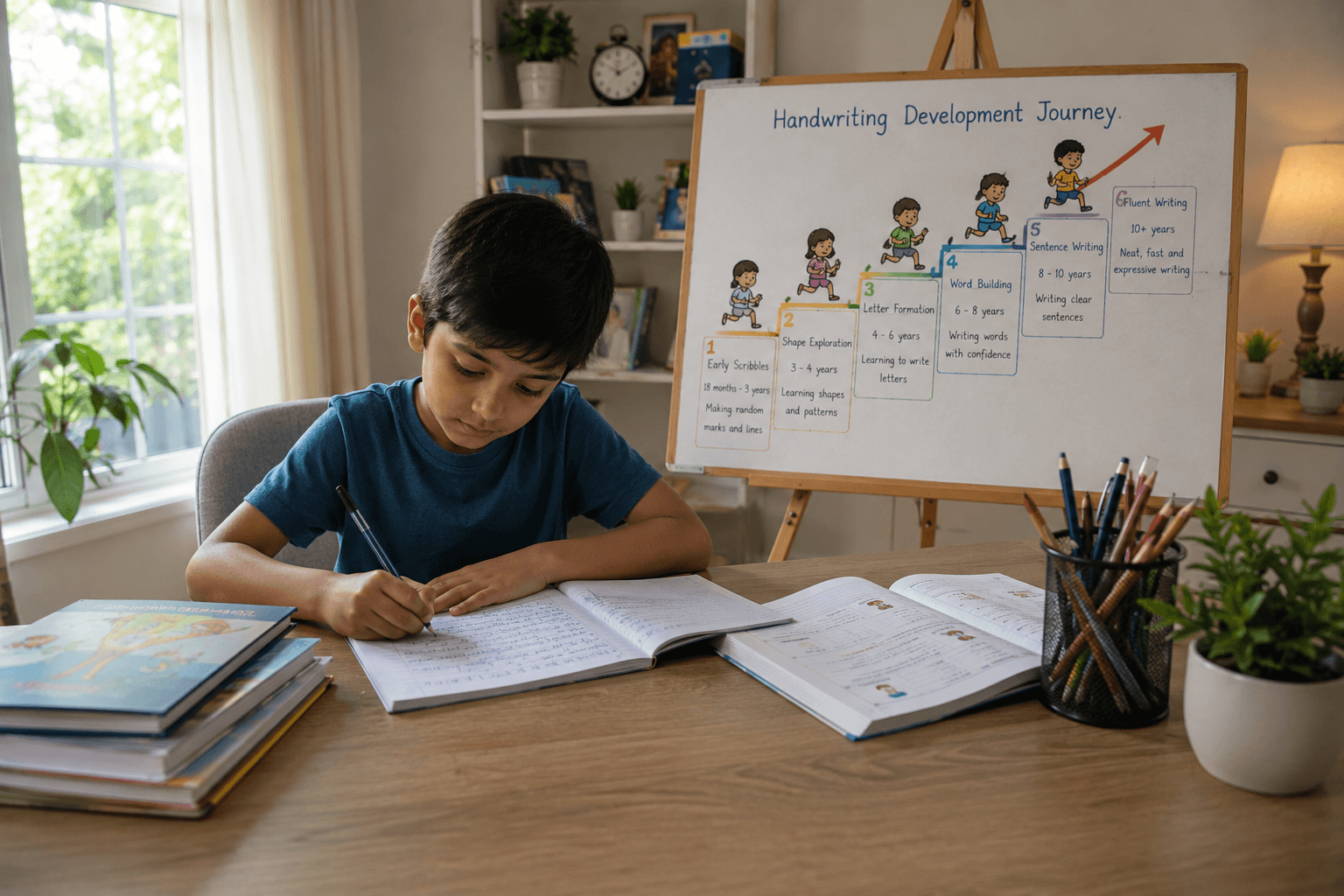
The Handwriting Development Journey: How Children Progress From First Strokes to Fluent Writing


Founder, Younglabs — partner across your child's learning journey
Engineering gold medallist · ISB Postgraduate · Building Younglabs across Foundations, Academic Excellence, University & Beyond
18 Aug 2026 · 16 min read
_____________Education
Two ways to fix this at home this week
Letter and word pages, sorted by age.
Book a free handwriting class (ages 5–13) →A child's handwriting can change dramatically between the first time they pick up a pencil and the point when they are expected to fill an entire page of schoolwork. In the early years, a child is working out how to control a pencil and reproduce simple shapes. A few years later, that same child may be expected to write quickly, maintain consistent letter formation, answer questions in complete sentences and keep going even when the task becomes tiring. Looking at both stages simply as “handwriting” misses how much development happens in between.
Handwriting is a gradual skill-building process. It involves fine-motor control, visual-motor coordination, letter formation, spacing, alignment, automaticity, speed and eventually the ability to write while concentrating on ideas rather than the physical act of forming every letter. These abilities do not necessarily mature at the same rate, which is why a child can have strong letter formation but poor writing speed, or neat handwriting that becomes difficult to maintain during longer assignments.
Understanding the full journey helps parents interpret what they see on the page more accurately. Instead of asking whether a child's handwriting is already neat, it becomes possible to ask a more useful question: what handwriting skill is developing at this stage, and what should come next?
A useful way to read your child's handwriting: Compare writing across different stages and types of tasks rather than judging one page in isolation. Improvement in control, consistency, comfort and independence can be just as meaningful as a visibly neater page.
Stage 1: Before Handwriting Begins, Children Build the Foundations
Want a page to practise on?
Letter and word pages, sorted by age.
Book a free handwriting class (ages 5–13) →The handwriting journey starts before children are expected to form recognisable letters. Activities such as drawing, colouring, building with small objects, using scissors, playing with blocks and manipulating crayons give children opportunities to develop the physical control that later supports writing.
Two abilities are particularly important here: fine-motor control and visual-motor integration. Fine-motor control allows children to make small, deliberate movements with their fingers and hands, while visual-motor integration helps them coordinate what they see with where and how they move their hand.
This explains why children of the same age can look very different when they first begin handwriting. One child may already have enough control to make small, deliberate marks, while another may still use larger movements and struggle to keep a pencil within a defined space. The difference does not necessarily reflect how much either child understands. Their underlying motor development may simply be at different points.
At this stage, parents do not need to turn every activity into handwriting preparation. Drawing a picture, colouring carefully, completing a simple maze or building something that requires controlled finger movements can all provide useful practice. The important development is that movements become increasingly deliberate rather than random.
Stage 2: Learning the Movement Behind Each Letter
Once children begin formal handwriting, they have to translate a visual symbol into a physical movement. Knowing what a letter looks like is not the same as knowing how to produce it efficiently.
A child may recognise B immediately but still start the letter from an inconsistent point, use unnecessary strokes or struggle to reproduce the same shape several times. Early handwriting therefore tends to contain considerable variation. Some letters may be oversized, others compressed, and the same letter may look different every time it appears.
This is a normal part of learning because children are still building motor patterns for writing. With repeated practice, the movements become more familiar and require less conscious planning. The aim is not to force perfect uniformity immediately but to help children develop a reliable way of producing each letter.
This stage is also where letter formation begins to influence later writing fluency. Efficient movements are easier to repeat than complicated or inconsistent ones. When children eventually have to write several sentences, those small differences in efficiency can have a noticeable effect on speed and fatigue.
Stage 3: From Individual Letters to Consistent Words
The next challenge arrives when children have to connect individual letters into words. This sounds like a small step, but it changes the physical demands of writing considerably. Instead of completing one movement and stopping, children have to coordinate several movements while maintaining reasonable control of size, spacing and alignment.
A child may therefore produce individual letters that look quite good but struggle when those same letters appear together. The writing may become crowded, letter sizes may change or the child may pause frequently between letters.
This is the point at which handwriting begins to shift from isolated skill practice towards functional writing. Children are no longer demonstrating that they can reproduce symbols; they are using those symbols to communicate words.
Parents can observe this transition by comparing isolated letter practice with ordinary words. If the letters look consistent individually but become increasingly uneven inside words, the child may still be developing the coordination required to combine movements efficiently.
Stage 4: Learning to Organise Writing on the Page
Once children can produce words with reasonable control, they have to learn how those words should occupy space. This involves more than simply leaving a gap between words. Children are developing an understanding of baseline alignment, letter proportions, margins, spacing and the overall visual structure of written language.
A sentence can contain perfectly recognisable letters and still be difficult to read if words are crowded together or letters gradually become larger. Similarly, writing that begins on the line but slowly drifts upward or downward can become harder to follow even when the individual letters remain clear.
These characteristics become easier to evaluate when looking at several sentences rather than a single word. Parents can ask whether the child's writing maintains roughly the same structure from the beginning to the end of a task.
A few variations are completely normal, particularly in younger children. The more meaningful question is whether the child is gradually becoming better at maintaining those features without needing constant reminders.
What to look for at this stage
- Consistent letter size across a sentence
- Clear separation between words
- Reasonably stable alignment with the writing line
- Similar letter formation throughout the page
- Increasing ability to maintain these features independently
These are not standards that have to be achieved perfectly at once. They are useful indicators of whether the child's control is becoming more stable.
Stage 5: Handwriting Starts Becoming Automatic
One of the most important developments in handwriting happens when children no longer have to consciously think about every letter they produce. This is known as automaticity, and it changes what children are able to do with writing.
Imagine a child who has to stop mentally to plan each letter. If that child is asked to write a paragraph, much of their attention is consumed by the physical act of writing. There is less cognitive capacity available for spelling, sentence structure, vocabulary or the ideas they want to communicate.
As familiar handwriting movements become more automatic, the balance changes. Children can devote more attention to the content of their writing because the physical production of familiar letters requires less conscious effort.
This is one reason handwriting development is closely connected with academic writing. The objective is not simply to produce attractive letters. It is to develop enough automaticity that handwriting does not become an unnecessary barrier to learning.
Stage 6: Developing Writing Fluency and Appropriate Speed
Automaticity and speed are related, but they are not the same thing. A child may write quickly without having good handwriting fluency if the writing becomes difficult to read or the child loses control of spacing and formation.
Writing fluency is better understood as the ability to produce reasonably clear writing at an appropriate pace without excessive hesitation or physical effort. The appropriate pace changes as children grow and their academic demands increase.
A younger child may need considerable time to write a short sentence because they are still developing the underlying movements. An older student may need to write several paragraphs during a lesson. If handwriting remains highly effortful, the increased workload can create fatigue and make the quality of writing deteriorate.
This is why parents should not judge handwriting speed from a short worksheet alone. A better indicator is how the child performs during ordinary school-style writing. Can they maintain readable handwriting while answering questions? Does their writing become significantly messier when they have to work faster? Do they take so long that they struggle to finish?
The answers help reveal whether the child is developing functional fluency rather than simply producing neat handwriting under ideal conditions.
Stage 7: Moving From Copying to Independent Writing
Copying is useful during handwriting development because it provides children with a continuous visual model. They can see the letter or word, reproduce it and immediately compare their version with the example.
Independent writing removes that support. The child now has to generate ideas, retrieve vocabulary, remember spelling, construct sentences and physically write them down. The additional cognitive demand can make handwriting appear less controlled, even when the child's basic formation skills are developing appropriately.
This is why a child may produce excellent handwriting while copying a paragraph but struggle when asked to write the same amount independently. The two tasks are testing different abilities.
Parents can learn a lot by comparing copied writing with dictated and independent writing. If copying is consistently strong but independent writing becomes much less controlled, the child may need more opportunities to practise writing without a visual model rather than simply doing more copying exercises.
Stage 8: Maintaining Handwriting During Longer Tasks
As children move through school, writing becomes longer and more demanding. They may need to answer multiple questions, write paragraphs, complete assignments, take notes or produce written responses within a limited amount of time.
This is where writing stamina becomes important. A child may have enough control to produce three neat lines but struggle to maintain the same quality across a full page. The handwriting can become larger, spacing can disappear, pencil pressure can increase and letter formation may become less consistent.
Parents can learn more from the change between the beginning and end of a writing task than from either section alone. If the first paragraph is controlled and the final paragraph is noticeably different, the child may be finding it difficult to sustain the same level of motor control and attention over time.
That does not automatically mean the child needs more handwriting drills. The underlying issue may involve fluency, endurance, task length or the amount of cognitive effort required to produce the writing.
Stage 9: Adapting Handwriting to Different Situations
Mature handwriting is not necessarily identical in every situation. Children eventually need to adjust their writing depending on what they are doing. A carefully completed assignment may look different from quick classroom notes, a timed test or a short answer.
The important development is flexibility. Children should be able to increase their pace when necessary without losing basic legibility, and they should be able to slow down when a task requires greater precision.
This is also where handwriting becomes increasingly connected with real academic demands. A student may understand a lesson perfectly but lose valuable time if writing remains extremely slow. Another student may finish quickly but make their answers difficult for a teacher to read.
The goal is therefore not maximum speed or maximum neatness. It is functional control: writing that is sufficiently clear, comfortable and efficient for the situation.
Stage 10: Handwriting Becomes a Tool for Learning
The final stage is less about what the handwriting looks like and more about what the child can accomplish through it. When handwriting has become sufficiently automatic, children can concentrate on their ideas instead of devoting most of their attention to producing individual letters.
They can answer questions, record information, write stories, explain their thinking and complete assignments without handwriting constantly getting in the way. They may still have an individual style, occasional inconsistencies or differences between fast and careful writing, but the underlying skill is functional and dependable.
This is an important shift because handwriting is ultimately a means of communication and learning. The end goal is not to create a page that looks like a handwriting worksheet. It is to give children enough control and fluency that they can use writing confidently when school and everyday life require it.
How Parents Can Understand Where Their Child Is in the Journey
Children do not move through these stages according to a perfectly fixed timetable. One child may develop strong letter formation early but take longer to develop writing speed. Another may write quickly but need more time to develop consistency and spacing. A child can also move forward in one area while temporarily struggling in another as the demands of school increase.
For this reason, parents should look at handwriting across different situations rather than relying on one carefully completed page. A handwriting worksheet, a piece of homework and an independent paragraph can reveal very different aspects of development.
When looking at your child's writing, consider whether the main change is related to formation, consistency, spacing, speed, endurance or independence. That observation can be more useful than simply deciding that the handwriting is “good” or “bad.”
It is also worth keeping occasional writing samples. Comparing work from several months apart can reveal improvements that are difficult to notice during everyday homework. A child may have become faster, reduced unnecessary pauses, improved spacing or gained enough confidence to write independently even if the overall style has not changed dramatically.
When Should Parents Seek Additional Support?
Most children experience periods of uneven handwriting development, and small inconsistencies are expected. However, persistent difficulties become more important when they interfere with schoolwork, cause significant frustration or make writing physically uncomfortable.
Parents may want to discuss handwriting with a teacher if a child consistently struggles with basic letter formation, finds writing unusually tiring, cannot maintain readable writing during ordinary classroom tasks or takes substantially longer than expected to complete written work. A noticeable difference between carefully practised handwriting and everyday classroom writing can also provide useful information.
Teachers see children writing under conditions that parents may not observe at home. They can compare the child's performance across copying, note-taking, worksheets, tests and longer assignments, which can help reveal whether the difficulty is related primarily to handwriting mechanics, fluency, stamina or the demands of independent writing.
Teacher perspective: Nidhi Dixit, Handwriting Educator, YoungLabs, “Handwriting develops in layers. Before expecting a child to write faster or produce longer answers, we need to make sure the basic movements and writing habits are becoming comfortable and consistent.”
The purpose of seeking support is not to label a child as having “bad handwriting.” It is to understand which part of the development process needs attention and make sure the child is given the right kind of practice.
Supporting the Journey at Home
The most effective handwriting practice changes as children develop. A child who is still working on basic control may benefit from activities that strengthen fine-motor and visual-motor skills, while a child with established letter formation may gain more from meaningful sentences, longer writing tasks and opportunities to develop fluency.
Parents can also avoid one of the most common problems with handwriting practice: continuing to repeat an earlier-stage activity after the child has already moved beyond it. Once letter formation is reasonably secure, endless rows of individual letters may offer less value than practising words and sentences. Once writing becomes reasonably fluent, the next challenge may be maintaining that quality during longer academic tasks.
A simple way to think about progress is to watch how much responsibility the child can take on independently. Are they still thinking about every letter, or can they write familiar words automatically? Do they need a model beside them, or can they produce sentences from their own ideas? Can they maintain readable handwriting for a few lines, or can they manage an entire assignment?
These changes show how handwriting gradually moves from a highly conscious physical task towards an efficient tool for communication.
The Real Goal of Handwriting Development
The full handwriting journey is not a race towards perfectly uniform letters. It is a gradual progression from controlled movement to independent, fluent written communication. Children first develop the physical foundations for writing, then learn reliable letter movements, combine those movements into words, organise writing on the page, develop automaticity and eventually learn to maintain control while handling longer and more demanding academic tasks.
The stages overlap, and progress is rarely perfectly linear. A child may make rapid progress with letter formation and then appear to slow down when longer assignments demand more stamina. Another may develop speed quickly but need more time to build consistency. These differences are part of development rather than evidence that every child should follow exactly the same timeline.
For parents, understanding this progression provides a better framework for judging handwriting. Instead of focusing only on whether the page looks neat, they can look at whether their child is becoming more controlled, consistent, comfortable, efficient and independent.
Ultimately, the strongest sign of handwriting development is not a notebook filled with flawless letters. It is a child who can sit down with a writing task, think about what they want to communicate, put those thoughts on paper with reasonable control and continue writing without the physical act of handwriting becoming an unnecessary obstacle.
Frequently Asked Questions
1. What are the main stages of handwriting development in children?
Handwriting develops gradually, beginning with fine-motor control and visual-motor coordination before children move into letter formation, word formation, spacing, page organisation, writing automaticity, fluency, independent writing and longer academic tasks. Children do not necessarily move through these stages at exactly the same pace, so one area may become stronger while another is still developing.
2. Why does my child's handwriting look good when copying but become messy when writing independently?
Copying gives children a continuous visual model, while independent writing requires them to generate ideas, retrieve vocabulary, remember spelling and construct sentences while physically writing. The additional cognitive demand can make handwriting less controlled. Comparing copied, dictated and independent writing can help parents understand whether the difficulty is with handwriting itself or with managing several demands at once.
3. At what age should handwriting become fluent?
There is no single age at which handwriting suddenly becomes fluent. Fluency develops as letter formation becomes increasingly automatic and children require less conscious effort to produce familiar writing movements. As academic demands increase, children should gradually become more efficient while maintaining reasonable legibility and comfort. The more useful question is whether writing is becoming easier and more independent over time.
4. Why does my child's handwriting become messy during longer writing tasks?
Longer assignments require children to maintain motor control, attention and writing pace for a greater period. If handwriting is still effortful, fatigue can affect letter formation, spacing, alignment and pencil pressure as the task continues. Looking at the difference between the beginning and end of a writing task can help parents understand whether writing stamina or fluency is still developing.
5. When should I be concerned about my child's handwriting development?
Occasional inconsistency is normal, but persistent difficulties become more important when they interfere with schoolwork, make writing unusually tiring or frustrating, or prevent a child from completing ordinary written tasks. If handwriting remains difficult despite appropriate practice, or there is a significant difference between carefully practised work and everyday classroom writing, parents can discuss the pattern with the child's teacher.
Ready to improve this handwriting?
Letter and word pages, sorted by age.
Book a free handwriting class (ages 5–13) →