Beyond Three Sentences: How Children Learn to Build Strong Paragraphs


Founder, Younglabs — partner across your child's learning journey
Engineering gold medallist · ISB Postgraduate · Building Younglabs across Foundations, Academic Excellence, University & Beyond
12 Sept 2026 · 18 min read
_____________Education
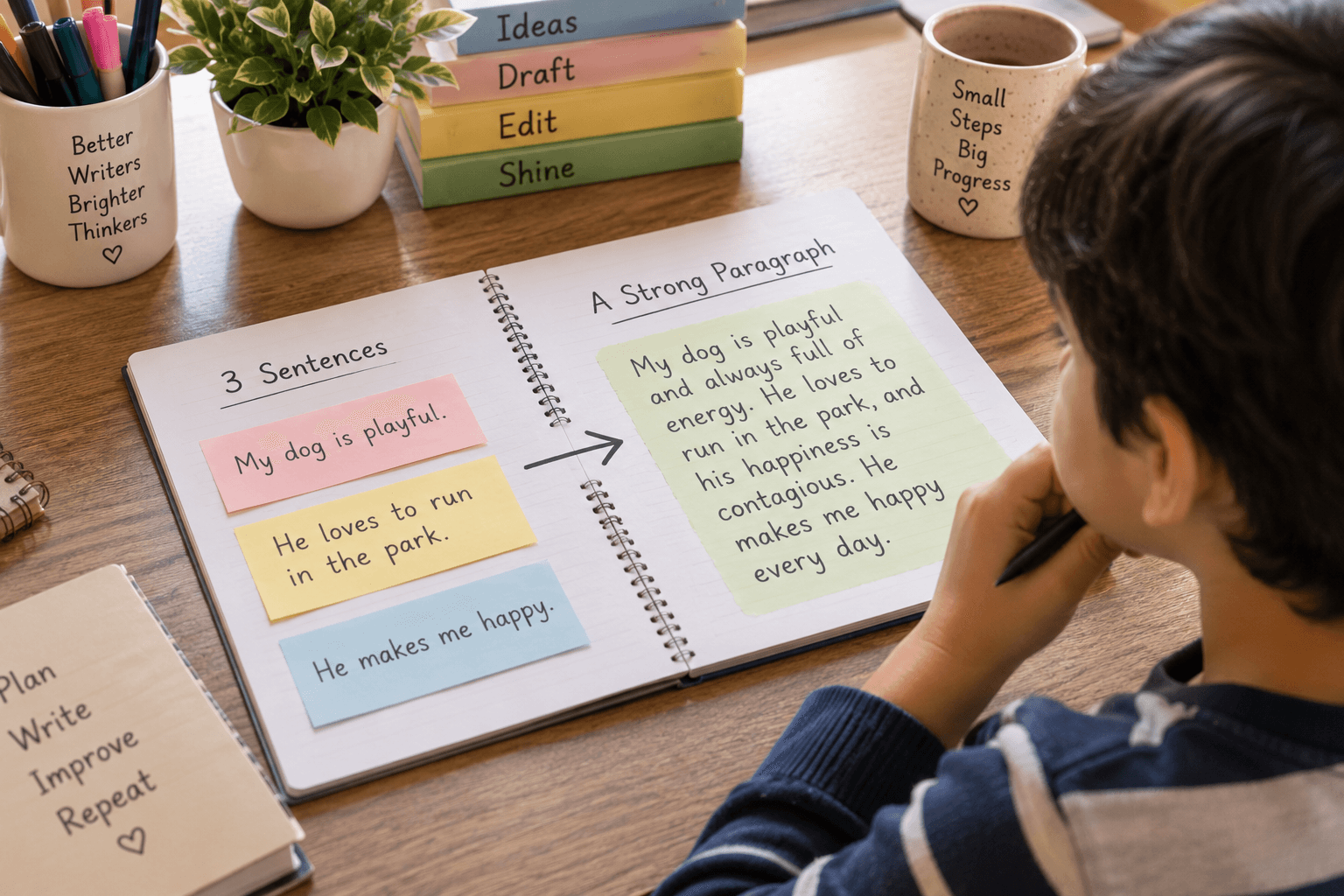
A child may be able to write three sentences about a topic and still struggle when asked to “write a paragraph.” At first, that can seem surprising. After all, a paragraph is made up of sentences, so if a child can produce three of them, shouldn't the task already be halfway done? In practice, the two skills are quite different. Writing separate sentences asks a child to express individual thoughts; writing a paragraph asks them to connect those thoughts, develop one central idea and guide the reader through it.
This is one reason children sometimes produce writing that is grammatically correct but still feels incomplete. They may write, “I like my school. My school has a playground. I play there with my friends.” Each sentence makes sense on its own, but the paragraph does not yet tell the reader much about why the school matters to the child or how the three ideas belong together. The child has information, but has not yet learned how to develop it.
Writing research supports the value of explicitly teaching these skills rather than simply asking children to write more. A meta-analysis of 24 studies involving 5,589 primary-grade students found that writing instruction had a positive overall effect on composition, with particularly strong effects for approaches that taught children strategies for planning, organising and regulating their writing. Research on sentence combining has also found that teaching children how to connect and reshape sentences can improve not only sentence fluency but broader measures of writing quality and essay length.
That makes three sentences a useful starting point rather than a finished paragraph. Instead of telling a child to simply “add more,” parents can help them understand what their reader needs to know, where an idea needs explanation, which details belong together and how one sentence can lead naturally into the next.
Why Do Three Sentences Often Feel Like a Paragraph Is Missing?
The problem is usually not that the child has too few sentences. It is that the sentences are not doing enough work together.
Consider:
I like animals.
Dogs are cute.
I have a dog.
There is a clear topic, but the writing still feels like a list. The first sentence introduces animals, the second suddenly narrows the topic to dogs, and the third gives a personal detail. Nothing explains the relationship between those ideas.
Now compare it with:
Dogs are my favourite animals because they are friendly and playful. I have a dog named Bruno, and I enjoy taking him for walks and playing with him in the evening. Spending time with him has made me understand why dogs can become such an important part of a family.
The difference is not simply that the second version is longer. The writer has chosen one central idea and developed it. The sentences now have different jobs: the first establishes the main idea, the second provides a specific example, and the third explains why that example matters.
This is the first distinction parents should make when helping with paragraph writing. If a child's writing feels weak, the solution is not automatically another sentence. Sometimes the better solution is to make an existing sentence more specific, explain the relationship between two ideas, or remove a sentence that does not belong.
Before asking a child to add more, check whether the three sentences have:
- A shared idea: They should clearly belong to the same topic.
- Different information: The child should avoid saying essentially the same thing three times.
- A logical connection: The reader should understand why the sentences appear together.
- Enough development: Important ideas may need a reason, example, explanation or description.
Once children begin noticing these differences, paragraph writing becomes less about counting sentences and more about communicating an idea.
Strategy 1: Find the Main Idea Before Adding More
The easiest way to strengthen three sentences is to first ask what they are really saying together.
Suppose a child writes:
My favourite season is winter.
It is cold outside.
I like drinking hot chocolate.
The sentences are related, but the child may not yet have identified the idea that connects them. Is the paragraph about winter weather? Favourite winter activities? Why the child enjoys winter?
If the child decides that the real idea is why winter is their favourite season, the writing immediately has a clearer direction. The three sentences can then be developed around that idea:
Winter is my favourite season because I enjoy the cool weather and the cosy activities that come with it. The cold days make it fun to wear warm clothes and spend more time indoors with my family. I especially enjoy drinking hot chocolate while reading a book on winter evenings.
The parent did not need to give the child a completely new topic or vocabulary. The original ideas were already there. The important step was helping the child identify the one thought that could hold the paragraph together.
This is also why strategy-based writing instruction can be useful. Research on elementary writing has found that approaches that explicitly teach children how to plan, organise and regulate their writing tend to produce stronger effects on writing quality than simply focusing on isolated transcription skills.
For younger children, the question can be very simple: “If you could tell the reader only one thing about these three sentences, what would it be?” Their answer often reveals the central idea they need to build around.
Strategy 2: Develop the Idea With “Why?”, “How?” and “For Example?”
Once the main idea is clear, the next challenge is helping children move beyond general statements.
Children frequently write phrases such as “It was fun,” “I liked it,” “My school is nice,” or “The book was interesting.” These sentences are not necessarily wrong. They are simply incomplete from the reader's point of view because they do not explain what made something fun, nice or interesting.
This is where three questions become particularly useful: Why? How? and Can you give me an example?
Imagine a child writes:
I enjoy playing outside. It is fun. I play with my friends.
Rather than correcting the second sentence, ask, “What makes it fun?” The child might explain that they play football, race each other or invent games. Those answers can then become the material for the paragraph:
I enjoy playing outside because I can spend time with my friends and play different games. We often play football, race each other, or make up our own games when we have finished our homework. Playing outside gives us a chance to be active while spending time together, which is why it is one of my favourite parts of the day.
The important thing here is that the parent is drawing out information the child already knows. The child does not need to suddenly become more imaginative or use advanced vocabulary. They need to learn how to look at a simple statement and ask what would help a reader understand it better.
A useful way to practise this is to take one sentence at a time. If the child writes, “My grandmother makes delicious food,” ask what she makes. If the child writes, “The trip was exciting,” ask what happened that made it exciting. If the child writes, “I like my classroom,” ask what the child sees, does or enjoys there.
Over time, these questions can become part of the child's own writing process rather than something a parent always has to ask.
Strategy 3: Connect Sentences Instead of Leaving Them as Separate Thoughts
Some children have plenty of information but write every thought as a separate sentence. Their paragraphs can therefore sound repetitive even when the ideas themselves are good.
For example:
We went to the zoo.
We saw lions.
The lions were sleeping.
There is nothing incorrect about these sentences, but they can be connected to make the relationship between the ideas clearer:
When we went to the zoo, we saw several lions sleeping in the shade.
Or the child might want to emphasise the sequence:
We went to the zoo in the morning, and one of the first animals we saw was a group of lions sleeping in the shade.
Sentence combining is useful here because it teaches children that sentences do not always have to remain isolated. Research has found that explicit sentence-combining instruction can improve sentence fluency and writing quality, including in elementary-age students.
Parents can introduce this naturally rather than turning it into a grammar exercise. Give the child two sentences that clearly belong together and ask, “Can you make these ideas sound more connected?” Sometimes the answer may involve because, when, although, so, while or another connecting structure. Sometimes the sentences are clearer when left separate. The important skill is learning to make a deliberate choice.
This also helps children move beyond repetitive patterns such as:
I like drawing. I like painting. I like colouring.
A stronger version might be:
I enjoy art because I can use different materials to create things. I like painting pictures, but I also enjoy colouring and drawing when I want to try a quick idea.
The writing feels more mature because the relationship between the ideas has become clearer.
Strategy 4: Replace Repetition With Specific Details
A paragraph can contain three or four sentences and still communicate very little if every sentence repeats the same general opinion.
Consider:
My classroom is beautiful.
My classroom is very nice.
I really like my classroom.
The child has technically written three sentences, but the reader has learned almost nothing after the first one. Instead of asking the child to write a fourth sentence, ask what makes the classroom beautiful or nice.
Perhaps there are colourful displays on the walls, a reading corner beside the window, plants that students take care of, or artwork created by the class. Those details give the reader something they can actually picture.
The paragraph might become:
My classroom is a bright and welcoming place. Colourful drawings cover one of the walls, and our books are arranged neatly beside the reading corner. I especially like seeing our own artwork displayed because it makes the classroom feel like a place that belongs to all of us.
This is a useful distinction for children to learn: a supporting detail should give the reader something new to understand, see or imagine.
The same principle works with almost any topic. If a child writes that a friend is kind, they can describe something the friend did. If they say a book is exciting, they can describe the part that kept them interested. If they say a holiday was memorable, they can explain the moment they remember most clearly.
Good paragraph writing becomes much easier when children stop asking, “What sentence should I add?” and start asking, “What does my reader need to know?”
Strategy 5: Put Ideas in an Order the Reader Can Follow
Even when children have relevant information and useful details, a paragraph can feel confusing if the ideas appear in an awkward order. Young writers often write information in the order in which it occurs to them, which is natural, but readers need the information arranged in a way that makes sense.
For example:
I bought a dinosaur model from the gift shop. We reached the museum at ten o'clock. I saw a huge dinosaur skeleton.
All three sentences belong to the same experience, but the order feels strange. The child has described something that happened at the end before explaining what happened at the beginning.
Rearranging the ideas gives the paragraph a clearer progression:
We reached the museum at ten o'clock and began exploring the different exhibits. One of the most exciting things I saw was a huge dinosaur skeleton. Before we left, I bought a small dinosaur model from the gift shop as a reminder of the trip.
The child has not needed additional information. They have simply learned to organise what they already know.
The best order will depend on the type of writing. A personal experience often follows time, while a descriptive paragraph may move from a general impression to specific details. An opinion paragraph may introduce a view before giving reasons, while an explanation may move from a cause to its result.
Parents do not need to teach all of these structures at once. It is enough to ask, “What should the reader know first?” and “What would make sense after that?” These questions encourage children to think about the reader rather than simply recording their thoughts as they occur.
Strategy 6: Give the Last Sentence a Purpose
Children are often told that a paragraph needs a concluding sentence, so they finish with something like:
I really like my school.
The problem is that the sentence may simply repeat the opening idea rather than bringing the paragraph to a meaningful close.
A stronger ending can show a feeling, result, reflection or final observation.
For example:
My family visited the beach during the holidays. We collected shells, built a sandcastle and played near the water. We stayed until the sun began to set, when the sky turned orange and pink. It was a simple day, but it became one of my favourite memories from the holiday.
The final sentence does not introduce a new subject. It gives the experience a sense of completion.
For children who struggle with endings, parents can ask, “What do you want your reader to remember after reading this?” If the paragraph describes an experience, the answer might be how the child felt. If it explains an idea, the final sentence might show why that idea matters. If it describes a place, the ending might return to the impression created at the beginning.
A conclusion does not always have to sound formal. It simply needs to make the paragraph feel finished.
Take One Set of Three Sentences and Build It Together
Once children understand the strategies individually, parents can combine them in one activity rather than giving them six separate exercises.
Start with:
I enjoy reading books.
My favourite book is about animals.
I read it with my brother.
First, ask what the three sentences have in common. The child might decide that the paragraph is really about why reading an animal book with their brother is enjoyable.
Next, use the questions why, how and for example to find useful details. What does the child like about the book? Which animals are in it? What do the siblings do while reading? Which part is most interesting?
Then consider whether any sentences should be combined or rearranged. Finally, ask what the reader should remember at the end.
The finished paragraph might look like this:
I enjoy reading books because they help me learn about things I do not see every day. My favourite book is about wild animals, and I especially like the pages about lions and elephants because they contain interesting facts about how these animals live. I often read the book with my brother, and we take turns reading the facts aloud and discussing our favourite animals. Reading together has made the book even more enjoyable and has become one of our favourite things to do at home.
The important part is not the exact paragraph. It is the thinking that happened between the three original sentences and the finished version. That process is what children need to practise.
Research on writing instruction supports this kind of guided, strategy-focused approach. Effective writing instruction does not simply increase the amount children write; it teaches them strategies and supports them while they learn to use those strategies independently. A broader IES-supported synthesis of elementary writing interventions similarly identifies teaching writing strategies, supporting students as they write, and developing foundational writing skills as important components of effective writing instruction.
How Parents Can Practise Paragraph Writing Without Turning It Into Another Worksheet
Paragraph writing does not have to be limited to school assignments. In fact, familiar experiences can give children better material because they already have something meaningful to say.
After a family outing, ask the child to write three sentences about what happened. Instead of immediately correcting the writing, choose one sentence and ask what else the reader might want to know. If the child writes about a favourite book, ask what made the book interesting and which part they remember best. If they write about a school activity, ask what happened first, what they enjoyed and what they learned. A photograph can work particularly well because it gives the child something concrete to observe and describe.
The parent can gradually reduce the amount of support. At first, you might ask several questions and help the child organise the answers. Later, you can simply say, “Choose one sentence that needs more detail.” Eventually, the child should be able to reread their own paragraph and notice where an idea feels unfinished.
That gradual shift matters. The purpose of guided practice is not to make the parent part of every writing task. It is to help the child develop an internal process for planning, developing and checking their own writing.
When Should Children Move Beyond the Three-Sentence Structure?
Three sentences are useful because they give beginning writers something manageable to work with, but children should not come away believing that every paragraph must contain exactly three sentences.
As their writing develops, some ideas will need only three sentences while others may require five, six or more. A story may need several sentences to establish what happened. A descriptive paragraph may need additional details to help the reader picture a place. An opinion paragraph may require several reasons before the writer can reach a conclusion.
The three-sentence approach is therefore best understood as scaffolding. It gives children a simple space in which to learn the more important skills: identifying a central idea, adding relevant information, connecting thoughts, organising ideas and ending with purpose.
Eventually, the child should stop thinking, “I need three sentences,” and start thinking, “I have an idea. What does my reader need to understand it?”
What Makes a Strong Paragraph?
A strong paragraph is not simply a collection of grammatically correct sentences, and it is not necessarily a long piece of writing. Its strength comes from the relationship between its ideas.
The reader should be able to recognise what the paragraph is about, understand how the supporting information relates to that central idea, and move from one sentence to the next without having to work out the connection themselves. The writer may use an example, explanation, description, reason or personal experience to develop the thought, but each part should contribute to the same overall purpose.
That is why turning three sentences into a paragraph is such a useful writing exercise. It gives children a small amount of material and asks them to practise several important decisions at once. They learn that writing is not about filling a page or reaching a particular number of sentences. It is about taking an idea and giving the reader enough information to understand it clearly.
With repeated practice, children can begin making those decisions independently. They start noticing when a sentence is too general, when two ideas need a stronger connection, when information is being repeated, and when a paragraph needs one more detail to feel complete. Those are the habits that eventually support stronger stories, descriptions, essays, school answers and longer pieces of writing.
Frequently Asked Questions (FAQs)
1. How can I turn 3 sentences into a strong paragraph?
Start by identifying the main idea shared by the three sentences, then develop that idea with relevant details, explanations, examples, or personal experiences. Children can also improve the flow by connecting related sentences, removing repetition, arranging ideas logically, and giving the paragraph a purposeful ending.
2. How can I teach my child to develop ideas in paragraph writing?
Ask questions such as “Why?”, “How?”, and “Can you give me an example?” after a general statement. These prompts encourage children to explain their thoughts instead of simply adding unrelated sentences. With practice, they can begin asking themselves what information a reader needs to understand the main idea clearly.
3. How can children add more details to a paragraph without repeating themselves?
Encourage children to replace broad or repeated statements with specific information. For example, instead of writing “My classroom is nice” several times, they can describe the artwork, reading corner, displays, or other details that explain what makes the classroom enjoyable.
4. What is the difference between three separate sentences and a paragraph?
Three sentences can each make sense independently while still feeling disconnected. A strong paragraph develops one central idea, gives the reader relevant supporting information, and creates a logical relationship between the sentences so that the ideas feel connected rather than listed.
5. How can sentence combining improve a child's writing?
Sentence combining helps children understand how related ideas can be expressed more smoothly. Research discussed in the article suggests that explicit sentence-combining instruction can support sentence fluency and broader writing quality, helping children move beyond repetitive short sentence patterns.