Common Matra Mistakes in Hindi Handwriting and How to Fix Them


Founder, Younglabs — partner across your child's learning journey
Engineering gold medallist · ISB Postgraduate · Building Younglabs across Foundations, Academic Excellence, University & Beyond
23 Aug 2026 · 20 min read
_____________Education
Two ways to fix this at home this week
Letter and word pages, sorted by age.
Book a free handwriting class (ages 5–13) →A child can know the Hindi alphabet, read familiar words aloud and still make surprisingly frequent मात्रा (matra) mistakes while writing. Parents often see this during homework: a sign disappears, the wrong vowel sign appears, a familiar word changes from one day to the next, or a child copies a word perfectly but cannot reproduce it when the book is closed. It is tempting to describe this as carelessness, but the writing itself can tell a more useful story.
Hindi writing requires children to coordinate several abilities at once. They have to hear the word, distinguish the vowel sound, connect that sound with its written representation, remember the complete word, form the अक्षर (letter) accurately and maintain the arrangement while writing at a reasonable pace. A child can therefore understand a word perfectly and still struggle to represent it on paper. Research and classroom-oriented literacy material also show that matra-related errors remain common in children's Hindi writing, including confusion between matras and between अक्षर with similar sounds.
This is why improving Hindi writing is not simply about making children complete more worksheets. The more useful question is what kind of mistake is occurring and at which point in the writing process does it appear? Once parents make that distinction, practice can become more targeted, less repetitive and considerably more useful.
Who is this guide for? This guide is particularly useful for parents of children aged 5–10 years who are learning Hindi writing, repeatedly confusing matras, making spelling errors or finding it difficult to move from copying words to writing them independently.
1. Start by Finding the Real Source of the Matra Mistake
Want a page to practise on?
Letter and word pages, sorted by age.
Book a free handwriting class (ages 5–13) →When a child writes a word incorrectly, the finished word shows the parent what went wrong but not necessarily why. A missing मात्रा (matra) can have several causes. The child may not have heard the vowel clearly, may know the sound but not remember its written form, may recognise the correct spelling but lose it while writing from memory, or may know exactly what belongs in the word but struggle to place it correctly while writing quickly.
Consider a child who writes किताब correctly while copying from a book but writes कताब during dictation. The child has already demonstrated that they can recognise the correct written form. The difficulty appears when the visual model disappears and the child has to retrieve the word independently. That is a different learning problem from a child who writes किताब incorrectly even when it is directly in front of them.
The same distinction can be made with दिन and दीन. If the child cannot hear or distinguish the relevant vowel difference, writing practice alone is unlikely to solve the problem. If the child can pronounce and identify both words but repeatedly selects the wrong written sign, the practice needs to focus more strongly on the connection between sound and written form. Hindi spelling resources similarly identify distinctions such as ि/ी, ु/ू, े/ै and ो/ौ as important sources of spelling confusion because changing the matra can change the word or its meaning.
This is why parents should resist correcting every error in exactly the same way. A child who needs help with sound discrimination should not receive the same practice as a child who needs independent retrieval. The finished notebook may look similar, but the learning requirement underneath it can be very different.
A useful home check
- Ask the child to copy five familiar words and observe the accuracy.
- Cover the model and ask the child to write the same words from memory.
- Dictate the words and compare the result with the previous attempt.
- Finally, ask the child to use one or two words in a short independent sentence.
If accuracy drops sharply when the model disappears, recall needs more attention. If the child remains inaccurate even while copying, the basic written pattern may not yet be secure. If the spelling is accurate in isolated words but deteriorates inside sentences, the child may be managing too many writing demands simultaneously.
2. Build the Sound–Matra Connection Before Expecting Accurate Spelling
Some matra mistakes begin before the child starts writing. If a child does not clearly distinguish the vowel sound, the written sign becomes something they have to guess rather than something they can confidently retrieve. This matters particularly when working with pairs such as ि and ी or ु and ू, where the vowel distinction is represented visually in the written word.
Parents can make listening part of Hindi writing practice rather than treating every difficulty as a handwriting problem. Take a small number of familiar words, pronounce them naturally and ask the child to listen for the sound that changes. Once the child can identify that difference, connect it to the written form and ask them to write the words. This creates a stronger relationship between pronunciation, spelling and meaning than copying the visual sign repeatedly.
For instance, दिन and दीन can help a child notice the distinction between ि and ी. The exercise becomes more meaningful when the child reads both words, discusses their meanings and then writes them without looking at the original. The same approach can gradually be applied to other vowel pairs rather than introducing every matra simultaneously.
This is especially relevant for parents searching for how to correct matra mistakes in Hindi because repeated errors involving one vowel pair may indicate that the child needs stronger sound awareness. More handwriting pages may simply give the child more opportunities to reproduce the uncertainty.
What to change when the same matra keeps returning as an error
- Say the word aloud before asking the child to write it.
- Ask which vowel sound they hear rather than immediately naming the matra.
- Let them compare two words where the vowel difference matters.
- Return to writing only after the child can identify the sound with reasonable confidence.
The purpose is not to turn handwriting practice into a pronunciation lesson. It is to make sure that the child has the information needed to choose the written form before asking the hand to reproduce it.
3. Teach Matras Through Word Construction, Not Endless Rows of Symbols
Children often encounter matras after learning individual Hindi letters, which can lead them to think of the matra as an extra mark that has to be attached to an already finished अक्षर (letter). In actual writing, however, the consonant and vowel sign work together to represent the sound structure of the word.
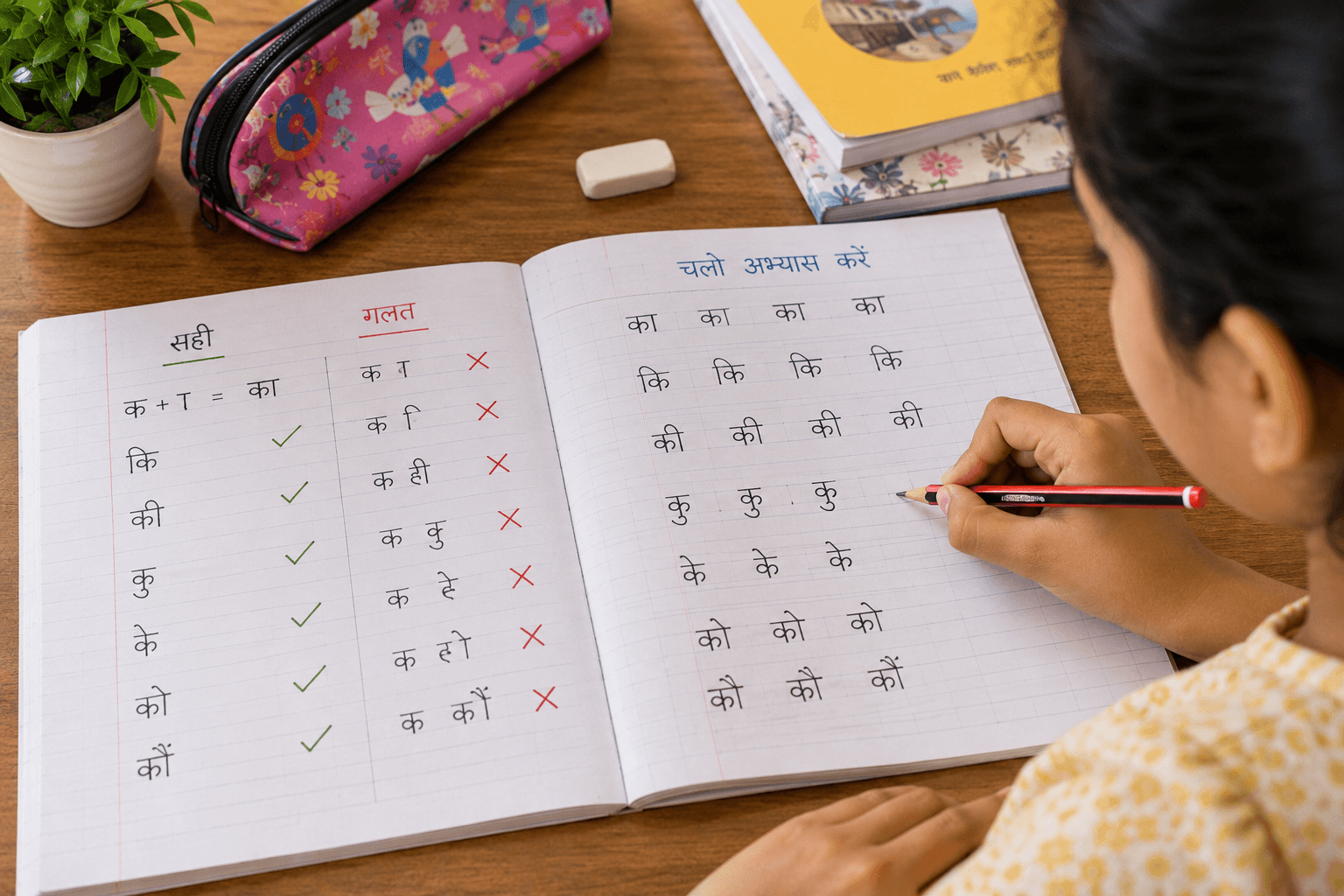
A child may be able to reproduce क, का, कि, की, कु and कू on a practice sheet but still omit the matra while writing किताब. The difference is that the isolated exercise gives the child a very obvious visual pattern, whereas the complete word requires them to construct and remember several elements simultaneously.
Hindi teaching material commonly introduces matras through consonant combinations and then moves into word examples, which is useful because children eventually need to transfer the pattern from isolated combinations into vocabulary. The important part for parents is not to abandon repetition altogether, but to avoid letting repetition become the entire learning experience.
After introducing a particular matra, use a few familiar words and then gradually remove the visual support. If the child has practised कि, for example, move into familiar words such as किताब or किरण and later ask the child to write one of them after hearing it. The word gives the child a meaningful reason to use the pattern, while the gradual removal of the model tests whether the pattern is actually becoming independent.
This approach also prevents a common problem in Hindi handwriting practice for kids: children becoming excellent at filling worksheets without becoming equally confident at producing Hindi words in ordinary schoolwork.
4. Give the ि Matra Extra Attention Because Its Visual Placement Is Different
The ि matra creates a particularly interesting challenge for beginning writers because its visual position can appear before the consonant even though the sound is read as part of the syllable that follows the consonant. A child looking at कि for the first time may therefore focus on the visual order rather than the sound relationship.
This is a recognised beginner difficulty in Hindi matra instruction, with teaching resources specifically noting confusion around the placement and reading of ि. The solution is not simply to repeat a rule louder or ask the child to fill more lines. The child needs repeated opportunities to see the complete combination, pronounce it and reproduce it as part of real words.
Begin with a small number of combinations such as कि, मि and पि, then move into familiar vocabulary. Once the child is comfortable with those forms, remove the model and ask them to write one or two words from memory. This helps establish the visual pattern as a complete unit rather than making the child consciously reconstruct the placement every time.
Parents should also distinguish between two different errors. If the child chooses ी when ि is required, the difficulty may involve sound or spelling recognition. If the child knows that ि is required but repeatedly places or forms it incorrectly, the difficulty is more visual or motor in nature. Those two situations should not automatically receive the same intervention.
5. Copying Can Hide a Child's Actual Spelling Ability
One of the most useful things parents can compare is copied writing with dictated and independent writing. When a child copies रीना किताब पढ़ती है।, the correct spellings remain visible throughout the task. During dictation, the child has to hear the sentence, hold the words in memory and construct their written forms without a visual model. During independent writing, they also have to decide what they want to say.
This explains why a child may produce a beautiful copied page and then make several matra errors in the next activity. It does not necessarily mean that the child was not paying attention. The two tasks simply require different levels of retrieval and language processing.
A stronger practice progression therefore reduces support gradually. Begin with a small amount of copying to establish the correct pattern, then cover the model and ask the child to reproduce selected words, followed by dictation and finally meaningful sentence writing. The child should not be expected to jump immediately from copying to a long paragraph, because the increasing demands can obscure the actual skill being practised.
When copying is no longer giving you useful information
- If the child can copy a word correctly several times, stop increasing the number of copies.
- Cover the model and check whether the child can reproduce the word independently.
- Use dictation to test whether the child can connect the spoken word with its written form.
- Put the same word into a sentence to see whether the child can retrieve it while thinking about meaning.
This progression is particularly valuable for parents trying to understand why children make Hindi spelling mistakes even after practising. Sometimes the child has practised the appearance of the word extensively but has had too few opportunities to retrieve and use it independently.
6. Sometimes the Matra Mistake Is Being Caused by the Physical Act of Writing
It is easy to separate language learning from handwriting development when looking at a child's notebook, but the two processes occur simultaneously. A child who is still concentrating heavily on forming each अक्षर (letter), maintaining size, controlling pencil movement or staying aligned has fewer attentional resources available for remembering spelling.
This becomes more visible when the writing task becomes longer. A child may write five dictated words accurately but begin dropping matras once asked to write several sentences. The parent may interpret this as declining concentration or laziness, while the actual problem may be that the physical demands of handwriting have increased enough to interfere with language accuracy.
Handwriting guidance for children commonly emphasises comfortable pencil control, letter formation, line awareness and practice, while literacy resources also show that matra-related spelling errors can persist even as children begin producing sentences. These observations are useful because they remind parents to look at the entire writing process rather than judging only the final spelling.
Watch what happens while the child writes. Frequent erasing, unusually slow formation, inconsistent letter size, difficulty maintaining alignment or a noticeable decline in accuracy as the writing task becomes longer can indicate that handwriting execution is contributing to the problem.
The solution is not necessarily more Hindi spelling practice. Sometimes improving the underlying writing fluency allows the child to devote more attention to spelling and sentence construction.
7. Help Children Recognise Patterns Instead of Memorising Every Word Separately
A child who has memorised ten words has not necessarily learned how the spelling system works. The difference becomes obvious when they encounter a new word containing a familiar matra. If they can only write words that have appeared on a worksheet, they may still be relying heavily on visual memory.
Pattern-based learning gives children a way to transfer what they already know. Once they have practised several familiar words, ask them to identify what those words have in common and then introduce another age-appropriate word with the same written pattern. The aim is to make the child notice that the same principle can appear across different words.
This matters because Hindi vocabulary expands rapidly as children progress through school. They cannot memorise every new word individually. They need increasing confidence in recognising sound patterns, written patterns and recurring combinations. Hindi matra resources similarly organise practice around recurring vowel-sign patterns across different consonants and words.
For younger children, the pattern can remain very simple. If they have worked with ु in a few familiar words, introduce another familiar word with the same matra rather than immediately adding a completely new group of vowel signs. For older children, the same idea can become more sophisticated by asking them to find words with a particular pattern while reading a short Hindi passage.
A useful test of whether the child has actually learned the pattern
- Give the child a familiar word they have practised before.
- Then introduce one new, age-appropriate word containing the same matra pattern.
- Ask the child to explain what looks or sounds similar.
- Finally, ask them to write both words without copying.
If the child can transfer the pattern to the new word, the learning is becoming more flexible. If they can only reproduce the familiar word, more work may be needed on recognising the underlying pattern.
8. Some Confusing Forms Need Meaning and Context, Not More Matra Drills
As children progress, they encounter spelling decisions that cannot always be solved simply by listening to the word. कि and की, for example, have different functions in a sentence. मैं and में also represent different words even though children can confuse their written forms. Hindi spelling resources identify these contextual pairs among common sources of writing errors.
This is the stage where sentence-based practice becomes much more useful than isolated copying. A child may memorise the difference between कि and की on a worksheet and still choose incorrectly while writing because the correct form depends on what the sentence means.
Rather than asking the child to copy both words repeatedly, give them short, meaningful sentences and discuss why one form belongs there. With मैं and में, for example, the child can learn to recognise whether the sentence is talking about the speaker or describing something being inside a place or object. The explanation should match the child's age; formal grammatical terminology is not necessary for a young learner to understand the difference.
This shift from symbol recognition to contextual understanding is an important part of developing stronger Hindi writing skills in students. As children become more advanced, accurate writing increasingly depends on meaning, vocabulary and sentence structure alongside the visual representation of sounds.
9. Turn Correction Into an Opportunity to Notice the Error
Parents naturally want to correct mistakes immediately, but providing the correct spelling before the child has looked closely at their own version can reduce the opportunity for self-correction. If every error is simply replaced with the correct answer, the child may become dependent on the adult to identify what went wrong.
A more productive approach is to ask the child to inspect the word. If they write किताब incorrectly, ask them to read what they wrote and compare it with the word they intended to write. Once they identify the missing or changed part, the parent can explain the difference and have the child reproduce the correct form. The corrected word should then appear again later in a different context so the child has to retrieve it rather than simply copy it immediately.
This approach is consistent with broader literacy practices that treat children's writing as something to analyse and develop rather than simply mark as right or wrong. Teacher resources on children's Hindi writing also identify matra and similar-sounding अक्षर as recurring spelling issues, particularly as children move into sentence-level writing.
The long-term objective is to help children develop an internal checking habit. They should gradually become able to notice that something looks unfamiliar, reread the word, reconsider the vowel and make a correction without waiting for an adult.
10. The Final Test Is Whether Matra Knowledge Appears in Real Writing
A child does not ultimately need to demonstrate Hindi writing ability by completing a worksheet. They need to use the language while answering a question, describing a picture, writing about a story or recording something they want to communicate.
That is why matra practice should eventually move into meaningful writing. After focused practice with a particular pattern, ask the child to write two or three sentences using familiar vocabulary. A younger child might describe a picture, while an older child could write a short response to a story they have read. The task should be appropriate to their current writing ability rather than deliberately made difficult.
Classroom literacy resources show that as children move into sentence-level Hindi writing, matra and similar-sound अक्षर remain important sources of spelling errors. They also show that simply producing sentences is not the end of writing development; children gradually need to improve organisation, vocabulary and sentence fluency as well.
This is why the final stage of practice should not be another spelling test. Ask whether the child can retrieve the word while thinking about what they want to communicate. If they can, the matra is beginning to become part of their functional writing rather than something they remember only when a worksheet tells them to.
Make the final practice step meaningful
- Use familiar vocabulary rather than introducing several new words at once.
- Give the child a reason to write, such as describing a picture or continuing a short story.
- Focus correction on the specific matra pattern being practised instead of marking every possible writing issue.
- Revisit the same vocabulary later so the child has to retrieve it again without a visual model.
This makes Hindi writing practice at home more closely resemble the writing children eventually need to do at school: thinking about meaning while simultaneously managing spelling, handwriting and sentence construction.
When Home Practice Is Not Enough
Occasional matra mistakes are a normal part of learning Hindi writing, particularly when children are moving from isolated अक्षर to words and then to independent sentences. What deserves closer attention is a persistent pattern that remains unchanged despite focused practice. If a child repeatedly confuses the same matras across copying, dictation and independent writing, struggles to form basic letters comfortably, or becomes extremely slow when asked to produce even short pieces of Hindi writing, teacher observation can help clarify what is happening.
The same applies when there is a large gap between spoken understanding and written performance. A child may be able to explain a story, answer questions verbally and read familiar words, yet struggle significantly when asked to put those ideas on paper. Looking at the difference between these activities can help a teacher determine whether the main challenge is spelling retrieval, handwriting fluency, sentence construction or the interaction between several skills.
Parents should also pay attention to the child's relationship with writing. If Hindi homework consistently produces frustration, avoidance or dependence on an adult for every word, adding more worksheets may not be the most productive next step. A teacher can observe the child directly and adapt the practice according to the specific pattern of difficulty.
Teacher Perspective — Reetu Prabha: When a child repeats the same matra mistake, it is more useful to understand the pattern behind it than to simply increase the number of words they have to write. Looking at how the child reads, copies, recalls and independently uses the word helps us decide what kind of practice will actually move the child forward.
What Effective Hindi Handwriting Practice Should Ultimately Achieve
The goal of Hindi handwriting improvement is not to create a child who never makes a spelling mistake. Children will continue to encounter unfamiliar words, more complicated sentences and new grammatical structures as their language develops. The more valuable outcome is that they gradually develop a process for approaching those challenges independently.
A child first learns to recognise a sound and its written representation, then learns how that representation works with different अक्षर. With practice, they begin to retrieve familiar words without a model, use those words in sentences and notice when something in their writing does not look or sound right. Over time, correction becomes less dependent on the parent because the child begins participating in the checking process themselves.
That is why a missing मात्रा should not automatically result in another page of copying. It should first prompt a more useful question: What does this particular mistake tell us about what the child has not yet made automatic?
Once parents begin looking at writing in this way, practice becomes more focused. A child who once depended on a model can gradually learn to retrieve words independently. A child who repeatedly confused vowel signs can develop stronger sound-to-symbol connections. And a child whose matra accuracy disappeared during longer writing tasks can receive support for the handwriting fluency that was making accurate spelling difficult.
The real achievement is not simply fewer corrections in the notebook. It is a child who increasingly understands why a word is written the way it is, can reproduce it without constant support and can check their own writing when something feels wrong. That is the foundation on which stronger Hindi writing skills can continue to develop.
Frequently Asked Questions
1.Why does my child keep making matra mistakes even after learning all the matras?
Learning to identify a matra in isolation is different from applying it accurately inside a word. A child may recognise ि or ी on a worksheet but still struggle to retrieve the correct form during dictation or independent writing. Comparing copying, recall and dictation can help parents understand where the difficulty occurs.
2.How can I improve my child's Hindi spelling at home?
Use a small number of recurring words rather than overwhelming the child with a large spelling list. Let the child read the words, understand their meaning, write them with support, reproduce them without looking and eventually use them in sentences. This gives practice a progression instead of relying entirely on repetition.
3.Why can my child copy Hindi correctly but not write it independently?
Copying provides a continuous visual model, while independent writing requires the child to retrieve the word from memory. If the difference is large, gradually move from copying to covered-model recall and then to dictation and sentence writing.
4.Should I make my child write a difficult word many times?
Repetition can reinforce a correct pattern, but repeated copying is not always the most effective response to a persistent error. If the child keeps making the same mistake after several repetitions, change the activity and ask them to identify the error, recall the word without the model or use it in a meaningful sentence.
5.How do I know whether my child's matra problem is actually a handwriting problem?
Look at whether the mistake changes with writing conditions. If the child writes the correct spelling slowly but begins omitting or misplacing matras when writing longer sentences or working faster, handwriting fluency may be contributing to the problem. A teacher can help distinguish this from a language or spelling difficulty.
Ready to improve this handwriting?
Letter and word pages, sorted by age.
Book a free handwriting class (ages 5–13) →