10 Effective Techniques to Avoid Mistakes While Writing for Kids


Founder, Younglabs — partner across your child's learning journey
Engineering gold medallist · ISB Postgraduate · Building Younglabs across Foundations, Academic Excellence, University & Beyond
28 Jul 2026 · 14 min read
_____________Education
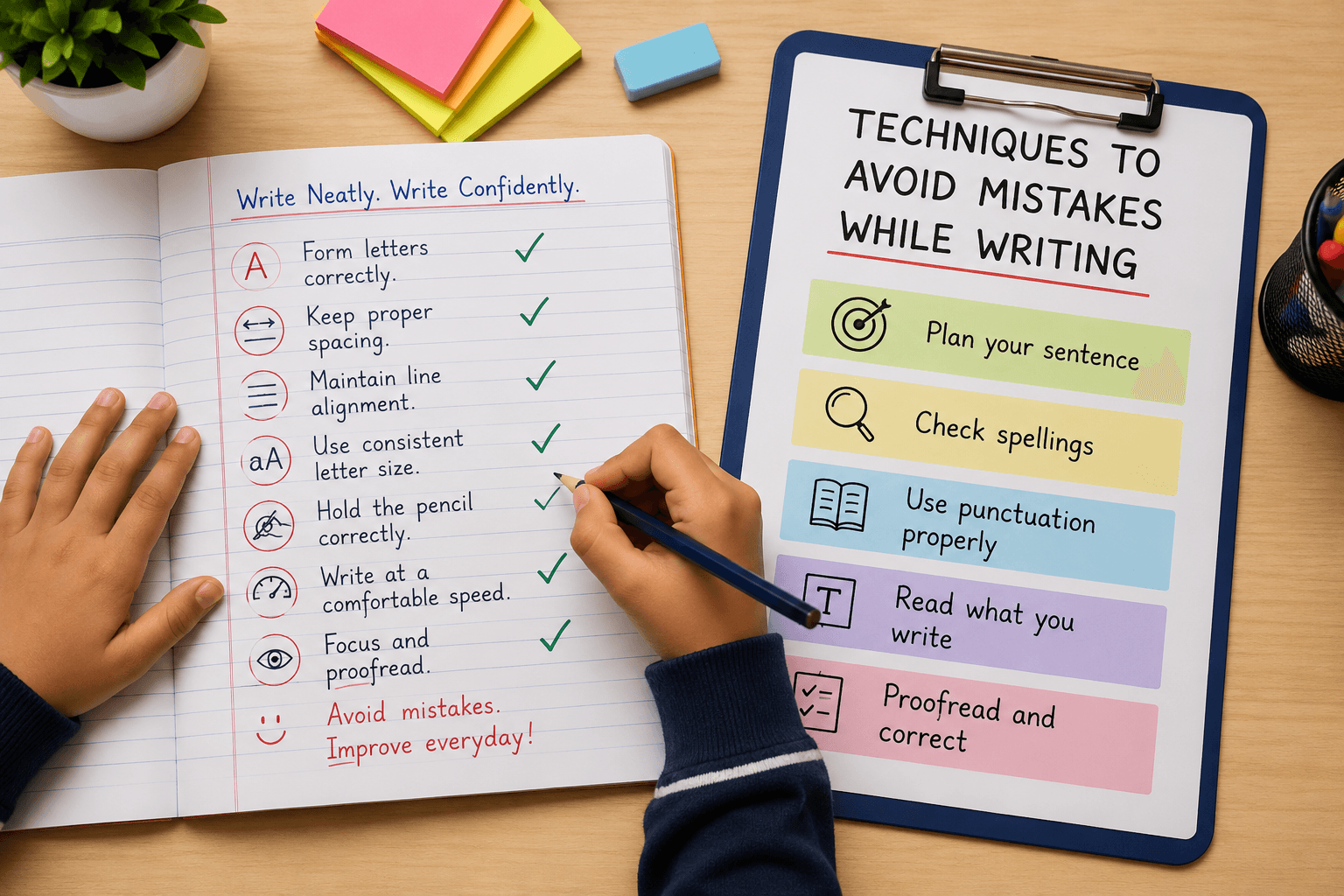
Children rarely sit down with the intention of making mistakes. Yet a notebook filled with crossed-out words, missing punctuation or incomplete sentences can make it seem as though they simply were not paying attention. The reality is usually more complicated. Writing is one of the few classroom activities where children are expected to think, organise, remember and communicate at the same time. Every sentence demands dozens of small decisions, and when even one of those decisions is rushed, small mistakes begin appearing almost unnoticed.
This is why avoiding mistakes is very different from correcting mistakes. Correction happens after the writing is finished. Good writing techniques influence the decisions children make while the writing is still taking shape. Over time, these techniques become habits, allowing children to produce work that feels more organised, easier to understand and far less dependent on constant correction.
The techniques below are not designed to make writing perfect. Instead, they help children reduce the kinds of mistakes that appear repeatedly during homework, classroom assignments and examinations.
1. Decide What You Want to Say Before You Start Writing
Many children begin writing the moment they recognise a question. Although this feels productive, it often creates unnecessary confusion. The first sentence becomes a place for thinking rather than communicating. Ideas change midway through, important points are forgotten and children frequently cross out words because the sentence has already moved in a different direction.
A brief pause before writing changes this process completely. Instead of discovering the answer while writing it, children already have a general direction in mind before the pencil reaches the paper. That simple shift reduces hesitation and helps every sentence contribute to the same central idea.
Imagine a child asked to describe their favourite festival. Without any planning, the paragraph may begin by describing the celebration, suddenly move to favourite foods, mention relatives visiting the house and then return to decorations. Each sentence makes sense on its own, but together they feel disconnected because the ideas appeared in the order they entered the child's mind.
A child who spends a few moments deciding what the paragraph will include usually produces a very different answer. The writing follows a natural sequence because every sentence supports the same idea instead of competing with it.
Planning does not mean preparing long outlines or writing rough drafts for every exercise. It simply means giving the brain enough time to organise thoughts before asking the hand to record them. That small habit often prevents mistakes that would otherwise require much longer to correct later.
2. Read Each Sentence While the Idea Is Still Fresh
Many children wait until the entire page is finished before checking their work. By that stage, their attention has already shifted away from the sentences they wrote at the beginning. Instead of carefully noticing mistakes, they often read what they intended to write rather than what actually appears on the page. As a result, missing words, incorrect verb forms and awkward sentences remain unnoticed even after a full review.
Reading each sentence immediately after completing it is a far more effective habit because the idea is still fresh in the child's mind. The brain can quickly compare what was intended with what has actually been written, making small mistakes much easier to recognise before they become part of a longer paragraph.
This habit also encourages children to look beyond spelling alone. As they reread each sentence, they gradually begin noticing questions that experienced writers ask themselves naturally.
- Does this sentence express my idea clearly?
- Have I accidentally left out a word?
- Will someone else understand exactly what I mean?
These questions are not about finding faults. They help children develop the ability to evaluate their own writing while it is still in progress. With regular practice, these quick checks become almost automatic. Instead of depending entirely on teachers or parents to identify mistakes, children begin recognising many of them independently. That growing independence improves not only writing accuracy but also the confidence to trust their own work.
By the time children have learnt to plan their ideas and read each sentence before moving forward, many of the obvious writing mistakes begin disappearing. However, teachers often notice that some errors continue to appear even in children who understand grammar rules and know the correct spellings. These mistakes are not usually caused by a lack of knowledge. They happen because good writing depends on consistency. A technique followed for the first three sentences but forgotten for the next three rarely changes the overall quality of writing. Developing consistency is what gradually turns careful writing into a natural habit rather than a conscious effort.
3. Keep Your Sentences Simple Before Making Them Impressive
As children become more confident, they often try to make their writing sound more advanced by using longer sentences or unfamiliar words. While this enthusiasm should always be encouraged, it sometimes creates a different problem. In an effort to sound impressive, children begin writing sentences that become difficult to control. Words are missed, punctuation becomes confusing and ideas that were perfectly clear at the beginning lose direction before the sentence reaches its end.
Teachers frequently remind children that clear writing is always stronger than complicated writing. A short sentence that communicates one complete idea is far more effective than a long sentence filled with unnecessary details that confuse the reader.
This does not mean children should avoid ambitious vocabulary or complex ideas. It simply means those ideas should be introduced gradually. As children become comfortable writing clear, complete sentences, they naturally develop the confidence to build longer ones without losing accuracy.
While reading their own work, children gradually begin recognising moments where a sentence feels heavier than necessary. Instead of asking whether the sentence sounds difficult, they begin thinking differently.
- Can I explain this idea more clearly?
- Have I added information that doesn't really help?
- Would separating this into two sentences make it easier to understand?
These questions encourage children to value clarity before complexity, a habit that continues to strengthen writing as they progress through school.
4. Pay Attention to the Mistakes That Repeat
Every child makes occasional mistakes, but recurring mistakes deserve much more attention than random ones. A spelling error that appears once may simply be a momentary lapse in concentration. The same spelling error appearing across several assignments usually indicates that the habit itself has not yet been corrected.
The same pattern applies to punctuation, sentence structure and handwriting. Some children consistently forget capital letters after full stops. Others repeatedly leave uneven spaces between words or skip smaller connecting words while writing quickly. Looking at each mistake separately often feels overwhelming, but recognising patterns makes improvement far more manageable.
Teachers rarely expect children to improve every aspect of writing at once. Instead, they identify one recurring habit, work on it consistently and then gradually move to the next area. This focused approach allows improvement to build steadily instead of dividing attention across too many corrections.
Children who begin noticing their own recurring patterns also become more independent writers. They stop viewing mistakes as isolated failures and start recognising them as habits that can be changed through regular practice.
5. Read Your Writing Like Someone Else Is Reading It
One of the reasons children overlook mistakes is because they already know what they intended to write. As they read their own work, the brain automatically fills missing words and corrects small errors without consciously noticing them. The page therefore appears clearer to the writer than it does to someone reading it for the first time.
Changing perspective can make reviewing much more effective. Instead of reading as the writer, children can gradually learn to read as the reader. This small mental shift encourages them to focus on whether every idea is complete rather than whether the page simply looks finished.
Many experienced teachers naturally read students' work this way. They pause wherever the meaning becomes unclear, not because the handwriting is untidy but because the sentence interrupts the flow of reading. Children can develop this same awareness through regular practice.
While reviewing, it often helps to pause after each paragraph and think about questions such as:
- If someone had never heard this idea before, would this explanation still make sense?
- Have I assumed the reader already knows what I am thinking?
- Did one idea connect naturally to the next, or did I move ahead too quickly?
These reflections gradually shift reviewing from correcting spelling alone to improving communication as a whole.
6. Accept That the First Draft Doesn't Need to Be Perfect
One habit that quietly prevents progress is expecting every sentence to be perfect the first time it is written. Children who constantly erase words, rewrite lines or stop after every sentence often interrupt their own thinking. Instead of developing ideas naturally, they become occupied with making every line flawless before moving forward.
Experienced writers rarely work this way. They understand that writing and improving are two different stages of the same process. The first draft allows ideas to appear on the page, while later revisions help those ideas become clearer, stronger and more accurate.
Helping children understand this difference reduces unnecessary pressure. They become more willing to express ideas without worrying that every sentence must immediately sound perfect. Ironically, this confidence often produces better writing because children spend less energy fearing mistakes and more energy communicating their thoughts clearly.
By this stage, writing stops feeling like a test of perfection. It becomes a process of planning carefully, writing thoughtfully and improving gradually—exactly the habits that help children make fewer mistakes over time.
By now, the techniques we've explored have focused on planning ideas, reviewing sentences, writing with clarity and developing habits that reduce mistakes before they become repetitive. The remaining techniques build on the same foundation. They are less about learning new writing rules and more about becoming aware of the small behaviours that quietly influence the quality of every piece of writing.
7. Give Yourself Permission to Pause While Writing
Children often assume that good writers never stop. They imagine that strong writing appears effortlessly from beginning to end, so they become uncomfortable whenever they need a moment to think. As a result, many continue writing even when they are unsure of the next sentence, hoping the right words will appear as they go. Unfortunately, this usually leads to repeated words, unfinished ideas or sentences that drift away from the original topic.
In reality, experienced writers pause far more often than children realise. They stop to choose a more suitable word, think about how one idea connects to the next or decide whether the previous sentence has fully explained the point they wanted to make. These pauses are not interruptions; they are part of the writing process itself.
Children who become comfortable with taking short thinking breaks often produce writing that feels more organised because every new sentence begins with greater clarity instead of uncertainty. A five-second pause before writing is usually more valuable than spending two minutes correcting a sentence that was rushed from the beginning.
8. Learn From Your Previous Mistakes Instead of Repeating Them
Many writing corrections disappear as soon as an assignment has been marked. Children glance at the teacher's comments, accept the corrected work and move on to the next exercise. While this completes the assignment, it does very little to improve future writing because the same mistakes often return a few days later.
Teachers rarely expect children to remember every correction they have ever received. Instead, they encourage them to notice the mistakes that appear repeatedly. A child who regularly forgets punctuation should not treat every missing punctuation mark as a new mistake. It is the same habit appearing in different places.
Looking back at previous assignments can therefore become just as valuable as completing new ones. Patterns begin to emerge naturally. Some children notice that they frequently miss small connecting words. Others realise they often leave sentences unfinished when writing quickly or forget capital letters after punctuation. Once these recurring habits become visible, improvement becomes much more focused because children know exactly what deserves their attention during the next writing task.
Progress in writing is rarely measured by making no mistakes at all. It is measured by making fewer of the same mistakes over time.
9. Read More to Become a Better Writer
Children often separate reading and writing as though they are completely different skills. One belongs to storybooks while the other belongs to notebooks. In reality, the two develop together much more closely than many people realise.
Every time children read, they are quietly collecting examples of sentence structure, punctuation, vocabulary and the natural rhythm of written language. They begin recognising how ideas are connected, where paragraphs change direction and why some explanations feel easier to understand than others. These observations happen naturally, even when children are reading simply for enjoyment.
This is one reason children who read regularly often develop stronger writing habits without consciously studying grammar every day. They have been exposed to thousands of correctly written sentences, allowing many language patterns to become familiar long before they attempt to use them in their own writing.
Reading therefore does more than improve vocabulary. It gradually builds an instinct for clear communication, making children less likely to repeat many of the writing mistakes that appear when language patterns are still unfamiliar.
10. Remember That Good Writing Is About Communicating Clearly
It is easy for children to believe that writing is a collection of rules waiting to catch them out. They worry about spelling every word perfectly, remembering every punctuation mark and avoiding every possible mistake. While these details certainly matter, they are not the ultimate purpose of writing.
The real purpose of writing is communication. Every sentence exists to help another person understand an idea. When children begin thinking this way, many of their writing decisions naturally improve. They choose simpler words when they communicate more effectively. They divide long sentences because they become easier to read. They review their work because they want their ideas to be understood rather than simply completed.
Ironically, children who focus entirely on avoiding mistakes often become hesitant writers because they are afraid of getting something wrong. Children who focus on communicating clearly usually become more confident writers, and that confidence gradually reduces mistakes as well.
Writing is not a skill that improves in a single week or through one workbook. It develops through hundreds of small decisions made every time children write a sentence, complete an assignment or express an idea on paper. Learning techniques that encourage planning, careful thinking, self-review and consistent practice helps children build habits that continue supporting them long after individual grammar rules have been forgotten. Over time, these habits become so natural that writing feels less like a task to complete and more like a skill they can trust in every classroom, examination and everyday situation.
Help Your Child Build Strong Writing Habits
Avoiding writing mistakes is not about expecting perfection from children. It is about helping them develop techniques that make writing clearer, more organised and more enjoyable with every practice session. When these habits are introduced consistently, children become more independent writers who can identify and correct many mistakes on their own.
If your child would benefit from structured guidance, personalised feedback and regular writing practice, YoungLabs' online handwriting course for kids helps children strengthen handwriting, improve writing accuracy and build the confidence to express their ideas clearly through expert-led online sessions.
Frequently Asked Questions
1.At what age should children start learning writing accuracy?
Children begin developing writing accuracy as soon as they start writing complete words and sentences. During the early years, occasional mistakes are expected, but gradually introducing good writing habits helps children become more accurate as writing tasks become longer and more challenging.
2.Can handwriting affect writing accuracy?
Yes. When children struggle with handwriting, they often spend more mental effort forming letters, leaving less attention for spelling, punctuation and organising ideas. As handwriting becomes more automatic, children can focus more on expressing their thoughts clearly, which often leads to fewer writing mistakes.
3.How can parents help children avoid mistakes while writing at home?
Parents can support writing by encouraging short, focused writing sessions instead of lengthy practice. Reading together, discussing ideas before writing and helping children review completed work without correcting every sentence immediately can gradually build stronger writing habits while keeping the learning experience positive.
4.How long does it take to improve writing accuracy?
Writing accuracy develops gradually because it depends on habits rather than memorising rules. With regular practice and constructive feedback, many children begin showing noticeable improvement within a few weeks, while lasting confidence continues to grow over months of consistent writing.
5.Why does my child keep making the same writing mistakes even after practising?
Repeated mistakes are often caused by writing habits rather than a lack of knowledge. If children continue rushing, skipping reviews or using incorrect letter formation, those patterns become automatic over time. Instead of increasing the amount of practice, it is often more effective to identify one recurring mistake and work on improving that habit consistently.