Why Your Child’s Handwriting Looks Uneven


Founder, Younglabs — partner across your child's learning journey
Engineering gold medallist · ISB Postgraduate · Building Younglabs across Foundations, Academic Excellence, University & Beyond
29 Apr 2026 · 5 min read
_____________Education
Two ways to fix this at home this week
Letter and word pages, sorted by age.
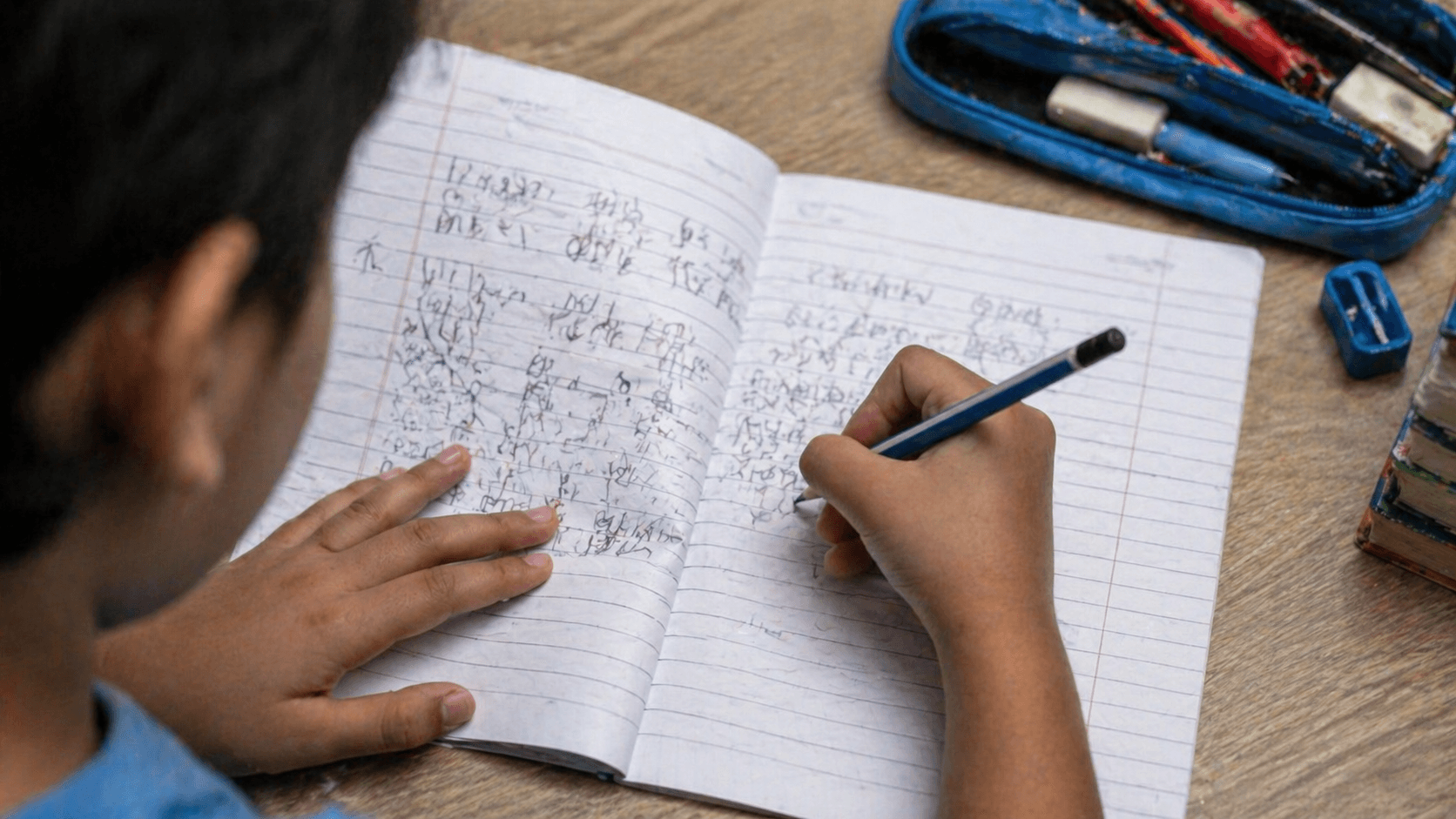
Book a free handwriting class (ages 5–13) →You don’t notice it on the first page. In fact, the first few lines usually look fine letters are clear, spacing is decent, and everything feels under control. But as the page continues, something changes. The lines begin to slope, some letters grow taller than others, spacing tightens in places and stretches in others.
By the time you reach the bottom of the page, the writing feels different from where it started.
That unevenness is not random. It tells a story not about carelessness, but about how your child is managing the act of writing in real time.
Uneven handwriting is rarely about “bad handwriting”
Want a page to practise on?
Letter and word pages, sorted by age.
Book a free handwriting class (ages 5–13) →What most parents label as “uneven handwriting” is usually a combination of multiple small inconsistencies happening together. It is not that the child doesn’t know how to form letters in fact, most children can form letters correctly when they slow down.
The issue appears when writing becomes continuous. When children have to think, write, maintain spacing, and keep up with pace simultaneously, their control begins to shift. Writing becomes less about precision and more about managing multiple demands at once.
This is why a child’s handwriting can look neat in one moment and uneven in the next. The skill exists but it isn’t stable yet.
Where the imbalance actually begins
The root of uneven handwriting often lies in how writing develops over time. Early on, children are guided closely they trace letters, follow lines, and focus on formation. But as they grow, that guidance reduces while expectations increase.
At this stage, children begin to rely on habits rather than instruction.
Some common patterns that quietly develop include:
- Writing faster than their control allows, leading to inconsistent letter size and spacing
- Holding the pencil tighter to gain control, which reduces flexibility in movement
- Focusing on finishing work rather than maintaining structure across the page
- Losing alignment as they move further down the page due to fatigue or reduced attention
These are not mistakes in the traditional sense. They are adaptations, the child trying to cope with writing demands using whatever feels manageable in the moment.
What it feels like from the child’s side
From the outside, uneven handwriting looks like a visual problem. From the child’s perspective, it often feels like a physical and mental load.
Writing is not just about the hand. It involves coordination between the brain, eyes, and muscles. When this coordination is not fully developed, the child has to constantly adjust while writing. That adjustment takes effort.
Over time, this effort shows up as:
- Slowing down midway through writing
- Losing consistency after the first few lines
- Feeling tired during longer writing tasks
- Becoming less attentive to spacing and alignment
This is also why children who do regular english handwriting practice for kids sometimes still struggle with consistency. The practice builds familiarity, but not always control.
The signs that point to uneven writing patterns
Instead of looking at handwriting as a whole, it helps to observe specific patterns. Uneven handwriting usually reveals itself in small but repeated ways:
- Letters do not sit consistently on the baseline, especially towards the end of the page
- Word spacing changes within the same sentence, making reading feel uneven
- Letter sizes fluctuate, with some letters appearing stretched while others shrink
- The writing starts neatly but gradually becomes rushed or compressed
These patterns indicate that the child is losing control as writing progresses, not that they lack the ability to write properly.
Why more writing doesn’t automatically fix it
A common instinct is to increase practiceWhen children repeat writing without understanding what needs to change, they reinforce the same patterns. This is why even after using handwriting worksheets pdf free or regular practice books, improvement may feel limited. more pages, more repetition, more correction. But uneven handwriting is not solved by volume alone.
What’s missing is not effort, but awareness.
Children need to understand how their writing behaves how spacing feels, how alignment works, and how movement should flow across the page. Without that awareness, practice becomes mechanical.
What begins to improve handwriting consistency
Improvement happens when writing becomes more controlled, not more forced. Instead of correcting everything at once, focusing on specific aspects creates better results.
For example, when children focus only on maintaining consistent spacing for a few days, they begin to notice patterns they were previously unaware of. Similarly, slowing down writing slightly allows the hand to move with more control, which stabilizes letter formation.
Structured tools can support this process:
- Printable handwriting practice sheets help children visually understand alignment and spacing
- A guided handwriting improvement course online introduces gradual progression instead of random practice
- Techniques like cursive handwriting for beginners step by step encourage continuous movement, reducing breaks that cause inconsistency
The goal is not perfection. It is stability making writing feel the same from the first line to the last.
A small shift that makes a big difference
One of the most effective changes is shifting attention from the final output to the writing experience itself.
When children are encouraged to notice how their writing feels whether it’s rushed, tight, or smooth they begin to adjust naturally. This awareness creates consistency over time.
It also reduces pressure. Instead of trying to make every page look perfect, the focus becomes making writing feel easier.
And when writing feels easier, it improves.
If your child’s handwriting looks uneven or inconsistent, don’t assume it’s just a habit that will fix itself. With the right approach combining small adjustments at home and structured guidance like online handwriting classes for kids writing can become smoother, more balanced, and far more comfortable.
FAQs
1. Why does my child’s handwriting start neat but become messy later?
Because maintaining consistency requires control and endurance. As the child continues writing, fatigue or reduced focus affects alignment and spacing.
2. Is uneven handwriting a serious issue?
Not necessarily serious, but it’s important to address early. If ignored, the same patterns can continue and affect writing speed and confidence.
3. How long does it take to make handwriting consistent?
It depends on the approach. With focused practice and proper guidance, noticeable improvement can be seen within a few weeks, but consistency develops gradually.
4. Should I correct my child every time their handwriting looks uneven?
Constant correction can create pressure. It’s better to guide gently and focus on one improvement area at a time.
5. Can online handwriting classes really help with consistency?
Yes, especially when they focus on structured learning and technique rather than just increasing practice.
Ready to improve this handwriting?
Letter and word pages, sorted by age.
Book a free handwriting class (ages 5–13) →