Why Does Your Child Write Too Slow or Too Fast? Causes and Solutions


Founder, Younglabs — partner across your child's learning journey
Engineering gold medallist · ISB Postgraduate · Building Younglabs across Foundations, Academic Excellence, University & Beyond
6 May 2026 · 8 min read
_____________Education
Two ways to fix this at home this week
Letter and word pages, sorted by age.
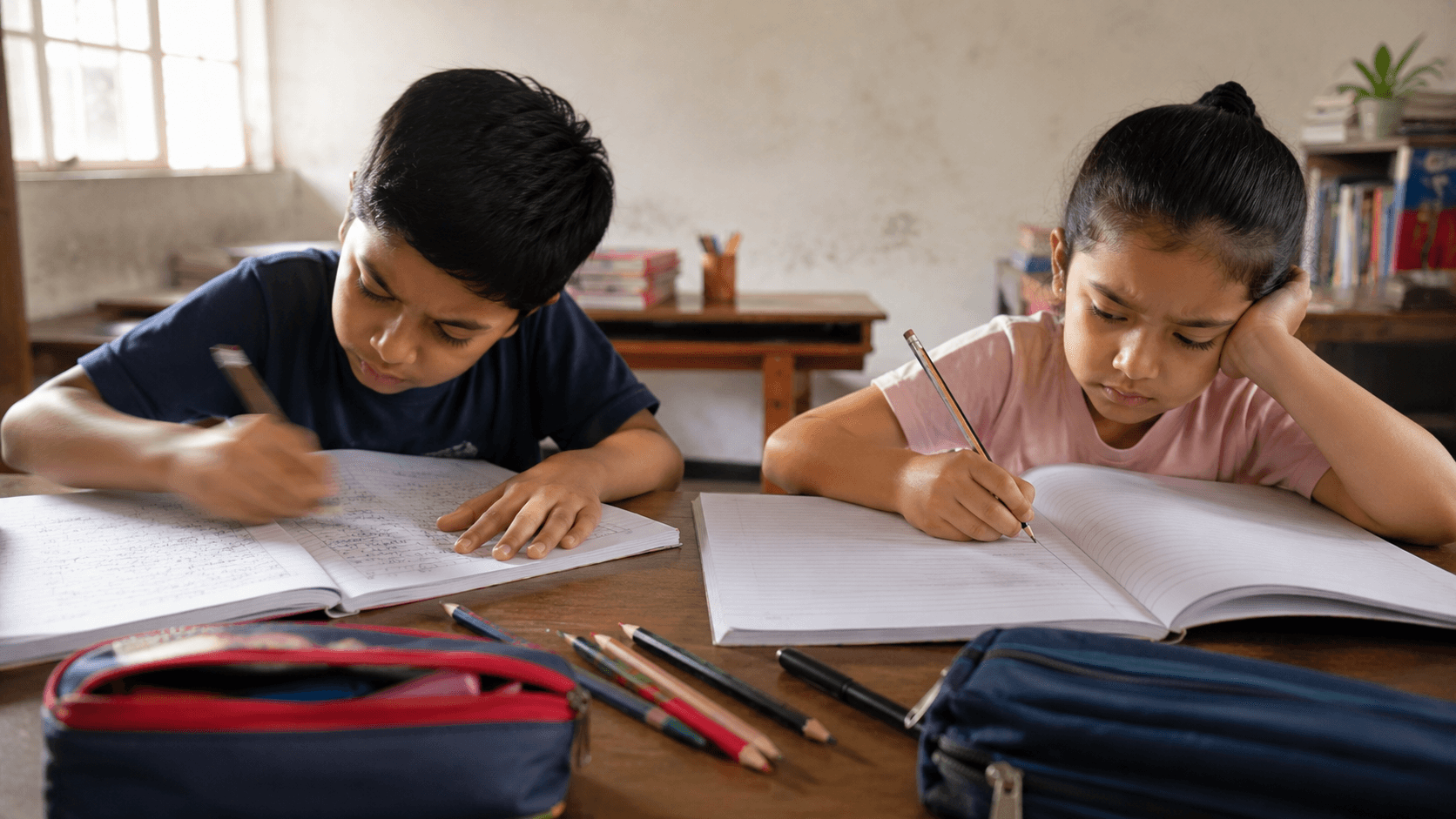
Book a free handwriting class (ages 5–13) →A parent once described her son’s homework routine in a way that quietly captures what many families experience but rarely talk about properly. She said, “If I ask him to solve maths questions orally, he answers instantly. But when he has to write those same answers down, it becomes a 40-minute struggle.” A few days later, another parent shared the complete opposite concern. Her daughter finished every worksheet within minutes, yet nobody, not even she herself sometimes could clearly read what she had written.
What makes handwriting confusing for parents is that both children appear to have opposite problems, yet the deeper issue is often surprisingly similar. One child is over-controlling every movement while writing, and the other is trying to escape the effort of writing as quickly as possible. Neither child has developed a healthy writing rhythm.
That distinction matters because handwriting is not just about neatness or speed. It is an advanced coordination task where thinking, movement, posture, pressure control, language processing, and emotional confidence all operate together at the same time. When even one of these systems becomes strained, children compensate unconsciously. Some slow themselves down excessively to avoid mistakes. Others speed up because writing feels tiring, mentally demanding, or frustrating.
This is one reason online handwriting classes for kids are no longer focusing only on “beautiful handwriting.” The better programs now work on writing flow, movement efficiency, spacing control, and writing confidence together because real handwriting improvement is rarely only about letter formation.
When Slow Writing Is Actually Mental Overload
Want a page to practise on?
Letter and word pages, sorted by age.
Book a free handwriting class (ages 5–13) →Children who write slowly are often misunderstood. Adults usually assume they are distracted, lazy, overdependent, or simply “too perfectionistic.” But if you observe carefully, many slow writers are actually putting enormous mental energy into basic writing mechanics that other children perform automatically.
These children are often thinking about:
- How the letter should look
- Whether spacing is correct
- If the line alignment is neat
- Whether the teacher will correct mistakes
- How much pressure they are applying with the pencil
By the time they finish one paragraph, they are mentally exhausted. Their hand may physically hurt, but more importantly, their brain has already spent too much energy managing the process of writing itself instead of focusing on ideas.
This is especially common in children around ages 8–10 because academic writing expectations suddenly increase. Earlier, children mostly copied small sentences or completed short classwork. Now they are expected to manage longer answers, faster classroom writing, paragraph formation, and organized notebook presentation simultaneously. A child who once seemed “fine” can suddenly begin struggling because the demands changed faster than their writing coordination matured.
One important thing parents often miss is that slow writing is not always caused by lack of intelligence or understanding. In fact, many thoughtful and academically strong children become slow writers precisely because they overthink every written detail. They want their english handwriting to look correct, readable, and controlled, so they continuously monitor themselves while writing. That constant self-monitoring slows natural movement dramatically.
Fast Writing Is Not Always Carelessness
Fast writers are judged differently. They are usually called careless, untidy, impatient, or irresponsible. But many children who rush through handwriting are not ignoring quality intentionally. They are trying to reduce discomfort.
Writing can feel exhausting for children in ways adults sometimes underestimate. Their fingers may fatigue quickly, their wrist may feel stiff, or their attention may drift before the task is complete. Instead of slowing down and managing the discomfort carefully, some children unconsciously develop the opposite survival strategy: finish quickly and escape the task.
This is why fast writers often show an interesting pattern. They may speak clearly, explain concepts confidently, and understand lessons well, but the moment extended written work begins, handwriting quality collapses. Spacing disappears, letters merge together, alignment drifts downward across the page, and punctuation becomes inconsistent.
A deeper observation many handwriting improvement course online educators now discuss is that fast writers are often “thinking ahead” of their hand movement. Their thoughts move faster than their motor coordination can comfortably keep up with. As a result, the brain begins sacrificing control for speed.
You may notice patterns like:
- Words shrinking toward the end of sentences
- Uneven pencil pressure across the page
- Missing letters inside familiar words
- Inconsistent handwriting style within the same paragraph
- Increased messiness during longer writing tasks
These are not random habits. They are signs that the child’s writing system is becoming overloaded.
What Most Schools Don’t Have Time to Observe
In a classroom environment, teachers understandably focus on output. They notice incomplete notes, slow test performance, or messy notebooks because those are immediately visible. What is harder to observe is the internal effort required for that writing.
Two children may submit equally untidy work for completely different reasons.
One child may be struggling with fine motor fatigue. Another may be rushing because sustained writing drains attention quickly. One child may hold the pencil with excessive pressure. Another may have developed weak spacing habits because writing speed became more important than control.
This is why simply telling children:
- “Write faster”
- “Slow down”
- “Be neat”
- “Practice more”
rarely produces lasting improvement.
Children need guidance that addresses the actual cause beneath the handwriting behavior.
A child who writes slowly often needs reduced pressure and smoother movement training. A child who writes too fast usually needs rhythm control, spacing awareness, and better writing pacing, not constant criticism.
The difference is important because repeated correction without understanding creates emotional resistance toward writing itself. Over time, children stop viewing handwriting as communication and begin seeing it only as a stressful performance task.
The Physical Side of Writing That Parents Rarely Notice
One of the most overlooked aspects of handwriting is how physical it really is. Many parents focus entirely on the notebook page while missing what the child’s body is doing during writing.
Children struggling with writing pace often display subtle physical signs long before handwriting visibly deteriorates.
Some children grip the pencil so tightly that finger joints become stiff within minutes. Others lean excessively close to the paper because visual coordination and movement control are not yet stable together. Some continuously adjust posture because their shoulder muscles tire quickly during longer writing sessions.
The body gives clues before the handwriting does.
A few signs that often indicate deeper writing strain include:
- Frequent complaints of hand pain after homework
- Deep pressure marks visible on multiple notebook pages
- Constant erasing and restarting
- Wrist lifting awkwardly while writing
- Slowing down dramatically during long answers
- Sudden handwriting deterioration after the first few lines
This is why effective english handwriting practice for kids cannot rely only on repetitive copying exercises. Real handwriting improvement usually happens when movement becomes easier, not simply when children practice longer.
Better handwriting programs today increasingly combine:
- Fine motor strengthening
- Pencil grip correction
- Rhythm-based writing drills
- Controlled spacing activities
- Timed writing flow exercises
- Relaxed paragraph writing practice
Because comfortable writing always develops before fast writing.
Why Writing Speed Affects Confidence More Than Parents Realize
Perhaps the biggest hidden consequence of handwriting struggles is emotional. Children quickly become aware of how their writing compares to classmates. Slow writers notice they are always the last to finish. Fast writers notice teachers repeatedly asking them to rewrite work. Over time, writing stops feeling like expression and starts feeling like embarrassment.
This emotional shift changes classroom behavior significantly.
Children struggling with handwriting pace often begin:
- Avoiding longer written answers
- Preferring oral participation instead of notebook work
- Losing confidence during tests
- Rushing homework emotionally
- Feeling anxious before written assignments
This is also why why is handwriting important for children goes beyond neat notebooks. Handwriting influences how comfortably children express knowledge itself. When writing feels physically or emotionally difficult, children gradually reduce how much they want to express on paper.
Parents sometimes focus so heavily on neatness that they unintentionally increase this pressure. Constant correction “your spacing is wrong,” “this looks messy,” “write properly again” can slowly make handwriting emotionally exhausting.
Children improve faster when they feel guided rather than judged.
Helping Children Find a Healthier Writing Rhythm
The solution is rarely forcing children into perfection. Sustainable handwriting improvement comes from balance.
Children who write slowly usually benefit from reducing over-control. Children who rush often benefit from slowing their mental pacing gently rather than through criticism.
Some highly effective handwriting habits include:
- Short but focused handwriting sessions instead of exhausting long practice
- Timed writing games without pressure
- Practicing flow before perfection
- Encouraging smoother continuous movement rather than letter-by-letter control
- Using printable handwriting practice sheets selectively instead of excessively
Most importantly, parents should observe whether the child looks physically relaxed while writing. Relaxed writing almost always improves over time. Tense writing usually becomes inconsistent no matter how many worksheets are completed.
If your child struggles with writing too slowly or rushing through every page, the goal should not be “perfect handwriting overnight.” Focus instead on helping them feel comfortable, balanced, and confident while writing. With the right guidance, supportive practice, and consistent routines, handwriting gradually becomes smoother, faster, and far less stressful for children.
FAQs
1. Why does my child take so long to finish written work?
Many children spend too much mental energy controlling handwriting mechanics instead of writing naturally. This slows overall writing pace significantly.
2. Is messy fast handwriting a sign of poor learning?
Not always. Many fast writers understand concepts perfectly well but struggle with pacing, spacing, or writing stamina.
3. Can handwriting speed improve naturally with age?
Partially, yes. But unhealthy writing habits often continue unless movement control and writing rhythm are addressed properly.
4. Are online handwriting classes for kids helpful for speed control?
Good programs can help because they focus on flow, grip, spacing, posture, and writing confidence instead of only neat copying exercises.
5. Should parents correct every handwriting mistake?
Constant correction usually increases writing pressure. Balanced guidance and positive observation tend to work much better long-term.
Ready to improve this handwriting?
Letter and word pages, sorted by age.
Book a free handwriting class (ages 5–13) →