Handwriting Standards in USA vs India: Key Differences


Founder, Younglabs — partner across your child's learning journey
Engineering gold medallist · ISB Postgraduate · Building Younglabs across Foundations, Academic Excellence, University & Beyond
7 Jun 2026 · 7 min read
_____________Education
Two ways to fix this at home this week
Letter and word pages, sorted by age.
Book a free handwriting class (ages 5–13) →Many parents become curious about handwriting standards only after comparing notebooks from different countries. A child studying in India may fill pages with neatly aligned writing, consistent margins, and detailed written work every day, while a child studying in the United States may complete fewer handwriting exercises but spend more time on creative writing, projects, and digital assignments. At first glance, one system may appear stricter and the other more relaxed. However, the reality is far more interesting. Both countries value handwriting, but they often approach it with different expectations, priorities, and educational goals.
Understanding these differences is especially useful for families moving between countries, enrolling children in international schools, or supporting children through global curricula. Handwriting standards are not simply about neat notebooks. They reflect broader educational philosophies about learning, communication, independence, creativity, and academic performance. When viewed through this lens, the differences between India and the USA reveal two distinct approaches to developing written communication skills.
The Purpose of Handwriting Looks Different
Want a page to practise on?
Letter and word pages, sorted by age.
Book a free handwriting class (ages 5–13) →One of the biggest differences lies in why handwriting is emphasized. In many Indian schools, handwriting is often viewed as an essential academic skill that directly influences classroom performance. Neat presentation, proper spacing, accurate letter formation, and clean notebook work are frequently encouraged from the earliest grades. Teachers may dedicate specific attention to handwriting practice because written work remains a major part of daily learning, homework, assessments, and examinations.
In the United States, handwriting is certainly taught, especially in elementary grades, but the focus often shifts more quickly toward written expression and communication. Once children develop basic legibility, teachers frequently prioritize the quality of ideas, sentence construction, critical thinking, and creativity over perfect presentation. Handwriting still matters, but it may not receive the same level of ongoing evaluation as it does in many Indian classrooms.
This difference does not mean one approach is better than the other. Instead, each system reflects different educational priorities. India traditionally places strong emphasis on academic discipline and written performance, while American classrooms often place greater emphasis on self-expression and communication effectiveness.
How Classroom Expectations Shape Handwriting Development
Children usually improve the skills that their environment consistently demands. This is why classroom expectations play such a significant role in handwriting outcomes.
In many Indian schools, students regularly:
- Complete extensive written exercises across subjects.
- Maintain multiple notebooks with structured formatting.
- Copy notes from boards or textbooks.
- Write longer answers during tests and examinations.
- Receive feedback on presentation and neatness.
These repeated activities naturally strengthen writing stamina, handwriting speed, and consistency because children spend substantial time physically writing each day.
In contrast, many American classrooms integrate a broader mix of activities. Students may participate in collaborative projects, digital assignments, presentations, classroom discussions, and research-based learning. Writing remains important, but the amount of repetitive handwriting practice can be lower in comparison. As a result, children may develop strong communication abilities while receiving fewer opportunities to refine handwriting mechanics through repetition.
Cursive Writing: A Noticeable Difference
Perhaps no area highlights the contrast more clearly than cursive handwriting. For decades, cursive writing held an important place in both educational systems. However, its role has evolved differently.
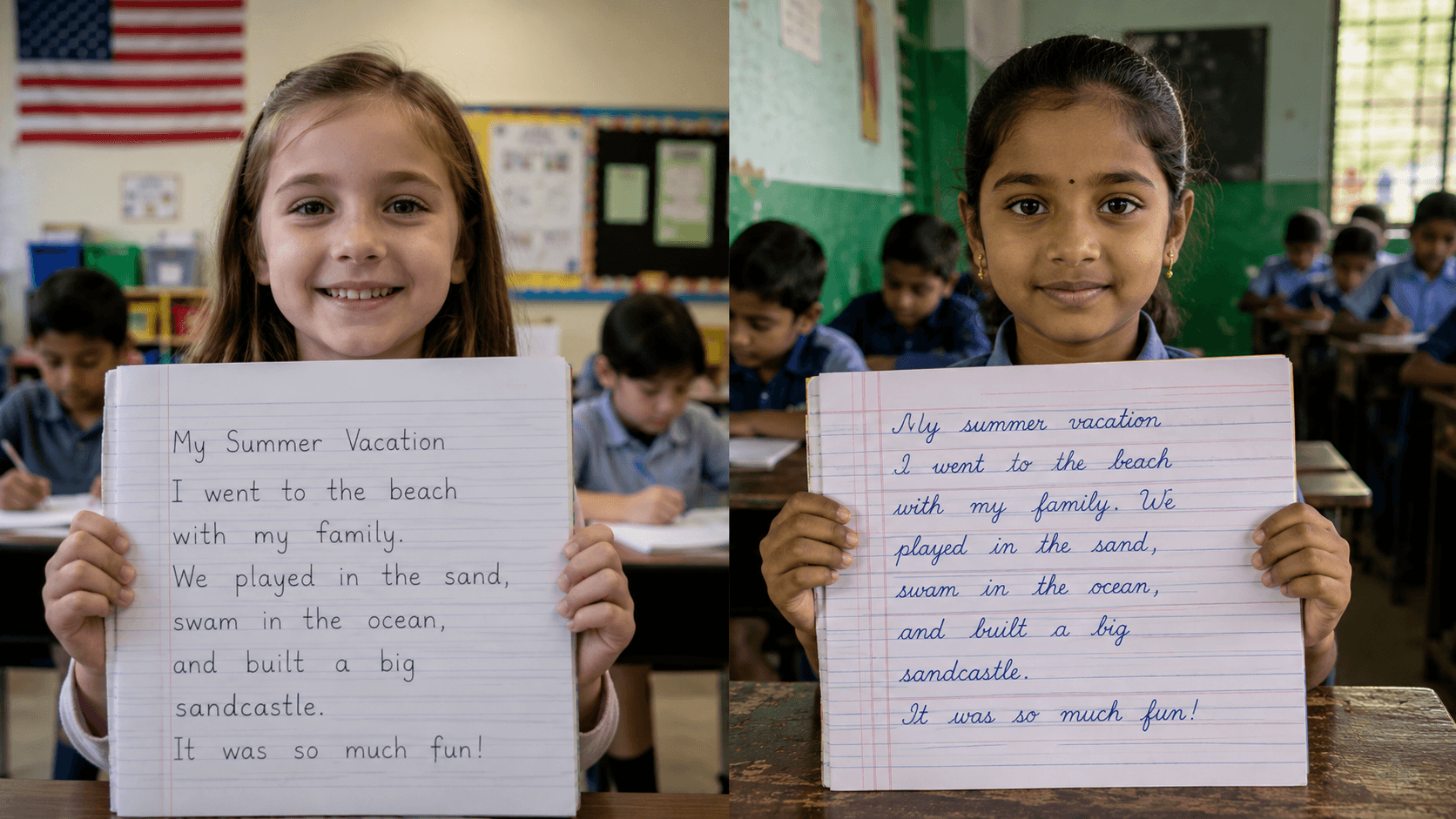
In many Indian schools, cursive handwriting continues to be actively taught and encouraged. Parents frequently enroll children in handwriting classes, cursive writing classes online for kids, and handwriting improvement programs because neat cursive writing is often associated with strong academic presentation.
In the United States, cursive instruction varies significantly depending on the state, district, or school. Some schools continue teaching cursive systematically, while others devote more classroom time to keyboarding and digital literacy. As technology became increasingly integrated into education, some schools reduced the emphasis on cursive instruction altogether.
The result is that many Indian students continue practicing cursive handwriting regularly, while American students may encounter a wider variety of handwriting styles, including manuscript, print handwriting, and digital communication methods.
What Parents Commonly Notice
Families relocating between the two systems often observe certain patterns that reflect these educational differences.
- Children coming from Indian schools may demonstrate stronger handwriting endurance and faster writing speed.
- Children educated in American classrooms may show greater comfort with creative written expression and open-ended responses.
- Indian students often develop highly structured notebook habits.
- American students may experience greater flexibility in writing styles and presentation formats.
- Both groups possess valuable strengths shaped by their learning environments.
These observations are general trends rather than universal rules. Individual schools, teachers, and students can vary significantly. However, they help explain why parents sometimes notice different handwriting habits when comparing educational systems.
The Growing Influence of Technology
Another factor shaping handwriting standards is the increasing role of technology. Both countries have embraced digital learning, but the integration often occurs differently depending on curriculum design, infrastructure, and educational philosophy.
As children spend more time using laptops, tablets, and digital platforms, handwriting naturally competes with other forms of communication. Some educators worry that reduced handwriting practice may affect fine motor development, writing fluency, and memory retention. Others argue that digital literacy is equally essential for modern success.
The most effective approach is usually balance. Children benefit from learning how to communicate through technology while also maintaining strong handwriting skills. Research and classroom experience consistently suggest that handwriting remains valuable because it strengthens attention, reinforces learning, supports memory, and develops fine motor coordination.
Why Handwriting Still Matters Regardless of Country
Although standards differ, one reality remains consistent across educational systems: children still need clear, readable handwriting. Whether a student studies in India, the USA, an IB school, or a Cambridge curriculum environment, illegible writing can create avoidable challenges.
Poor handwriting clarity may lead to:
- Reduced confidence during written tasks.
- Difficulty completing assignments efficiently.
- Lower-quality presentation of strong ideas.
- Increased frustration during examinations.
- Reluctance to engage in extended writing activities.
This is why parents searching for how to improve handwriting for kids often discover that the goal is not beautiful calligraphy. The goal is functional clarity. Children should be able to express their ideas comfortably without handwriting becoming a barrier.
Finding the Best of Both Approaches
Rather than choosing one system over another, many educators believe children benefit most from combining strengths from both educational cultures. Strong handwriting foundations provide structure, discipline, and writing fluency. At the same time, creative expression and flexible communication help children become confident thinkers and writers.
A balanced handwriting development plan often includes:
- Regular english handwriting practice for kids.
- Opportunities for creative writing and self-expression.
- Focus on readability rather than perfection.
- Activities that strengthen fine motor skills.
- Consistent but manageable handwriting practice routines.
When these elements work together, children develop handwriting that supports learning rather than restricting it.
Looking Ahead
The future of handwriting will likely continue evolving as educational systems adapt to changing technology and workplace demands. However, handwriting is unlikely to disappear completely. Even in highly digital environments, children continue using handwriting for note-taking, brainstorming, examinations, classroom activities, and personal communication.
The conversation is no longer about choosing handwriting or technology. Instead, it is about helping children use both effectively. Schools in India and the USA may emphasize different aspects of handwriting development, but both ultimately share the same objective: enabling children to communicate their ideas clearly and confidently.
Parents who understand these differences are better equipped to support their children without comparing one system unfairly against another. The most important measure is not whether a child's handwriting matches a particular country's standard. The real question is whether the handwriting allows the child to learn, communicate, and participate comfortably in everyday academic life.
Whether your child follows an Indian, American, IB, or international curriculum, clear handwriting remains an important life skill. Consistent practice, supportive guidance, and balanced expectations can help children build handwriting that supports both academic success and confident communication.
FAQs
1. Is handwriting more important in India than in the USA?
Handwriting is valued in both countries, but Indian schools often place greater emphasis on presentation, neatness, and consistent written practice throughout the school years.
2. Do American schools still teach cursive handwriting?
Some do, while others focus more heavily on print writing and digital literacy. Requirements vary between schools and districts.
3. Why do Indian students often have stronger handwriting stamina?
Many Indian schools require extensive daily written work, which naturally builds writing endurance, speed, and consistency over time.
4. Does technology reduce the need for handwriting skills?
Technology changes how children communicate, but handwriting remains important for note-taking, exams, learning retention, and fine motor development.
5. Which approach is better for children?
Neither approach is universally better. Children benefit most when they develop both strong handwriting foundations and effective communication skills.
Ready to improve this handwriting?
Letter and word pages, sorted by age.
Book a free handwriting class (ages 5–13) →