Handwriting Plan for 9–11 Year Olds with Poor Clarity


Founder, Younglabs — partner across your child's learning journey
Engineering gold medallist · ISB Postgraduate · Building Younglabs across Foundations, Academic Excellence, University & Beyond
5 Jun 2026 · 8 min read
_____________Education
Two ways to fix this at home this week
Letter and word pages, sorted by age.
Book a free handwriting class (ages 5–13) →Many parents become concerned about handwriting around the ages of nine to eleven because this is usually the stage when handwriting problems stop looking like a temporary phase and start affecting everyday schoolwork. During the early primary years, messy writing is often accepted as part of learning. However, by the time children enter higher grades, teachers expect longer written responses, structured paragraph writing, project work, note-making, and independent assignments. At this point, poor handwriting clarity begins creating challenges that extend beyond presentation alone.
What often surprises parents is that children in this age group usually know exactly what they want to write. They understand concepts, answer questions verbally, and participate confidently in discussions. Yet when those same ideas need to be transferred onto paper, the final result can look rushed, uneven, difficult to read, or poorly organized. The issue is rarely intelligence or understanding. More commonly, it is a handwriting system that never developed strong foundations and now struggles to keep pace with increasing academic demands.
The good news is that handwriting clarity can improve significantly between the ages of nine and eleven because children are mature enough to understand patterns, follow structured practice, and become aware of their own writing habits. What they need is not endless copying work but a clear plan that targets the real causes behind unclear handwriting.
Why Handwriting Clarity Often Declines Around Ages 9–11
Want a page to practise on?
Letter and word pages, sorted by age.
Book a free handwriting class (ages 5–13) →Many children experience a noticeable drop in handwriting quality during these years because the nature of schoolwork changes dramatically. Earlier grades focus heavily on learning letters, words, and basic sentence formation. As children grow older, their attention shifts toward ideas, comprehension, problem-solving, and written communication. The brain begins prioritizing content over presentation.
This creates an interesting situation. A child who once wrote carefully may suddenly develop messy handwriting because they are trying to think faster than their hand can comfortably write. They focus on completing maths worksheets, writing paragraphs, preparing project responses, and answering longer questions. As mental workload increases, handwriting control often receives less attention.
Parents frequently notice a few recurring signs:
- Letter sizes become inconsistent throughout a page.
- Words begin merging together because spacing disappears.
- Writing starts neatly but deteriorates after several lines.
- Certain letters become difficult to identify.
- Writing speed increases while readability decreases.
These patterns are extremely common and usually indicate that the child needs structured handwriting improvement rather than simple reminders to "write neatly."
Step One: Fix Readability Before Chasing Beautiful Handwriting
One of the biggest mistakes adults make is expecting beautiful handwriting immediately. Children with poor clarity should first focus on readability. If every letter can be identified clearly and every word can be read comfortably, substantial progress has already been made.
Many parents compare their child's writing to social media examples of perfect cursive handwriting or highly stylized handwriting fonts. Unfortunately, this comparison often creates frustration because clarity and beauty are not the same thing. Clear handwriting forms the foundation. Stylish handwriting develops later.
For the first few weeks of improvement, encourage children to focus on three simple goals: consistent letter size, adequate spacing between words, and recognizable letter formation. Once these become automatic, other aspects of handwriting naturally begin improving.
A Weekly Handwriting Plan That Feels Manageable
Children rarely benefit from hour-long handwriting sessions. Consistency matters much more than duration. Short daily practice creates better long-term improvement because the brain receives regular opportunities to reinforce movement patterns.
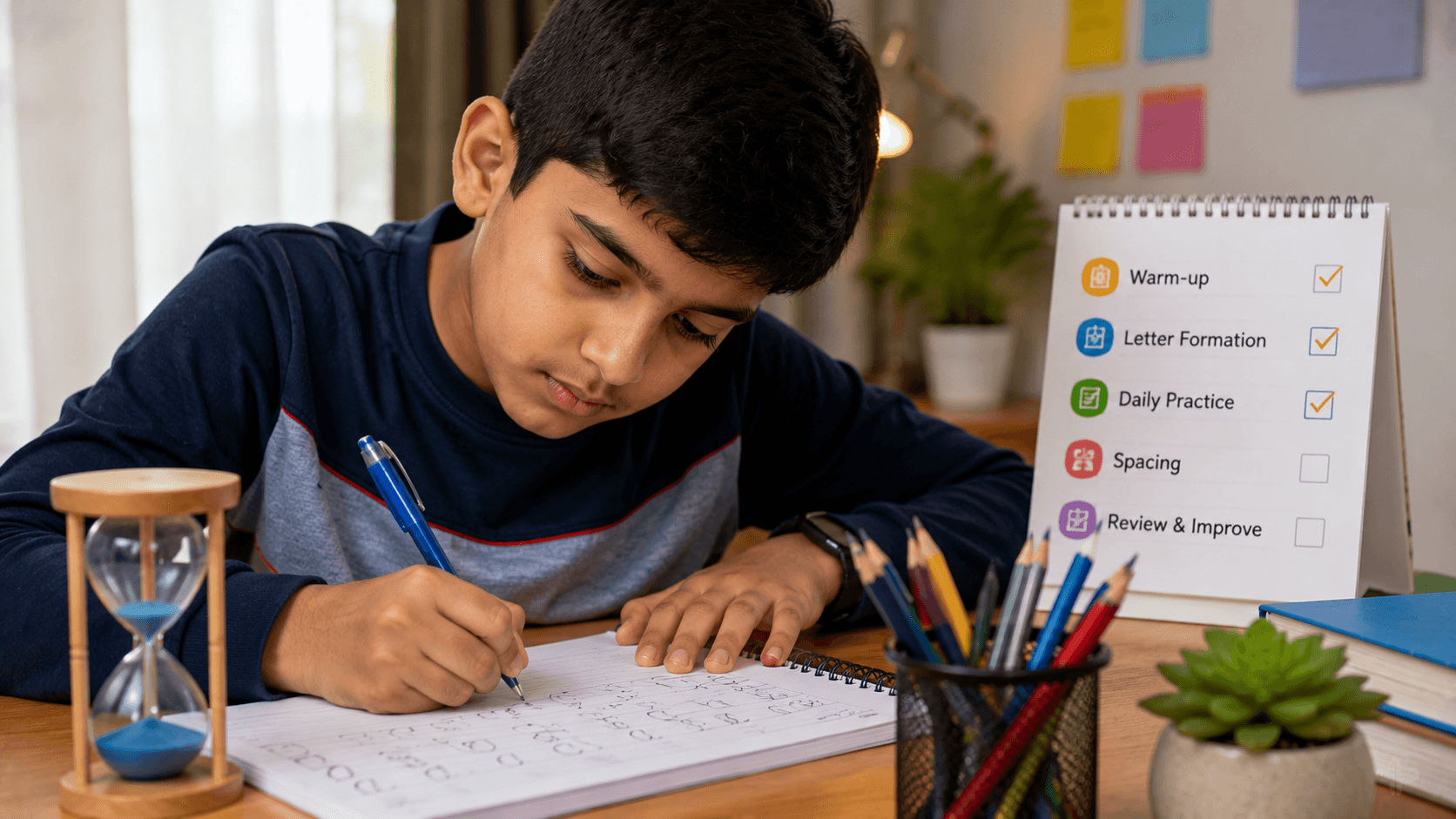
A practical weekly structure may include:
- Five to ten minutes of focused handwriting practice on school days.
- One session dedicated to letter formation.
- One session focused on spacing and alignment.
- One session focused on writing speed without sacrificing clarity.
- Two sessions using paragraph writing or creative writing activities.
This approach prevents boredom while ensuring that different handwriting skills develop together instead of in isolation.
The Hidden Role of Fine Motor Control
Sometimes children genuinely want better handwriting but struggle to achieve it because their hand muscles fatigue quickly. Parents often assume the problem is lack of effort when the real issue is physical control.
Handwriting depends on several fine motor skills working together. Finger strength, wrist stability, pencil grip development, pressure control, and hand endurance all influence how clearly a child writes. When these areas remain underdeveloped, children may press too hard, grip the pencil awkwardly, rush movements, or become tired during longer writing tasks.
Activities that strengthen these skills often support handwriting improvement surprisingly well:
- Drawing detailed sketches and pencil art.
- Using clay, putty, or molding activities.
- Cutting shapes accurately with scissors.
- Tracing patterns and geometric designs.
- Building small craft projects requiring precision.
These activities feel less repetitive than traditional handwriting practice while strengthening many of the same movement systems.
Why Writing Speed Should Not Be Ignored
Around the age of ten, many children become increasingly aware of classroom speed. They notice classmates finishing assignments earlier, copying notes faster, or completing tests more comfortably. In response, some children start writing rapidly without maintaining control. Unfortunately, this usually causes handwriting clarity to decline further.
The goal is not to slow children down indefinitely. Instead, they need to learn how to balance speed and readability together. Children should first develop consistent handwriting patterns at a comfortable pace. Once those patterns become automatic, writing speed naturally increases without sacrificing quality.
A useful strategy involves asking children to rewrite short passages while maintaining identical letter size and spacing throughout. This helps them understand that speed should grow from control rather than replace it.
Small Habits That Create Big Improvements
Parents often search for one breakthrough technique, but handwriting usually improves through small daily adjustments rather than dramatic changes. Several habits consistently produce noticeable results over time:
- Encourage children to sit with proper posture instead of writing while lying down or twisting awkwardly.
- Use ruled paper when practicing letter size consistency.
- Ask children to review their writing after completion rather than correcting every mistake immediately.
- Focus on one improvement goal at a time instead of correcting multiple issues simultaneously.
- Celebrate visible progress rather than aiming for perfection.
Children who feel successful are far more likely to continue practicing than children who feel constantly criticized.
When Handwriting Starts Affecting Confidence
Poor handwriting rarely remains a handwriting issue alone. By the age of nine to eleven, children become increasingly aware of peer comparisons and teacher feedback. Some begin avoiding writing-heavy tasks altogether. Others shorten answers because writing feels exhausting. A few develop the belief that they are poor writers when the real challenge is simply handwriting clarity.
Parents often notice subtle changes before children openly discuss their frustration. Homework takes longer. Notebook work appears rushed. Written answers become shorter despite strong verbal understanding. These signs suggest that handwriting support may be needed before confidence begins declining further.
The encouraging reality is that children often regain confidence quickly when handwriting becomes easier to manage. As clarity improves, writing feels less stressful. Longer answers become achievable. School tasks require less effort. The improvement frequently extends beyond handwriting into broader academic participation.
Creating a Long-Term Improvement Mindset
The most successful handwriting journeys usually happen when families stop treating handwriting as a short-term correction project and begin viewing it as a skill that develops gradually. Just as reading fluency or maths confidence improves through steady practice, handwriting follows the same pattern.
Children between nine and eleven are in an excellent stage for improvement because they possess the maturity to understand feedback while still remaining flexible learners. With structured practice, realistic expectations, and consistent encouragement, even children with poor handwriting clarity can make substantial progress within a few months.
Rather than aiming for perfect handwriting, aim for handwriting that feels comfortable, readable, and reliable. Those qualities support academic success far more effectively than decorative writing styles ever will.
If your child is between nine and eleven years old and struggling with handwriting clarity, remember that improvement is still very achievable. A structured plan, consistent practice, and the right guidance can transform handwriting from a daily frustration into a comfortable and confident skill that supports learning across every subject.
FAQs
1. Why does my 10-year-old still have messy handwriting?
Many children focus more on ideas than presentation at this age. If handwriting foundations such as spacing, letter sizing, or fine motor control remain weak, clarity issues can continue into upper primary grades.
2. How long does it take to improve handwriting clarity?
Most children begin showing noticeable improvement within four to eight weeks of consistent practice, although long-term development depends on regular reinforcement.
3. Should children practice cursive handwriting if their print handwriting is unclear?
Generally, handwriting clarity should improve first. Once letter formation and spacing become consistent, cursive handwriting can be introduced more successfully.
4. Can online handwriting classes for kids help older children?
Yes. Structured online handwriting classes often provide targeted feedback, personalized correction, and systematic practice that many children do not receive through independent practice alone.
5. What is the biggest mistake parents make while helping with handwriting?
Trying to correct everything at once. Children usually improve faster when parents focus on one specific goal, such as spacing, letter size, or alignment, before moving to the next area.
Ready to improve this handwriting?
Letter and word pages, sorted by age.
Book a free handwriting class (ages 5–13) →